Skip to content

Practice anchors install (w/ pictures!)
General Climbing
11 5 653 1
  • Okay, I did a thing.

    Yesterday I briefly outlined my plans to build a set of practice anchors in my garage.

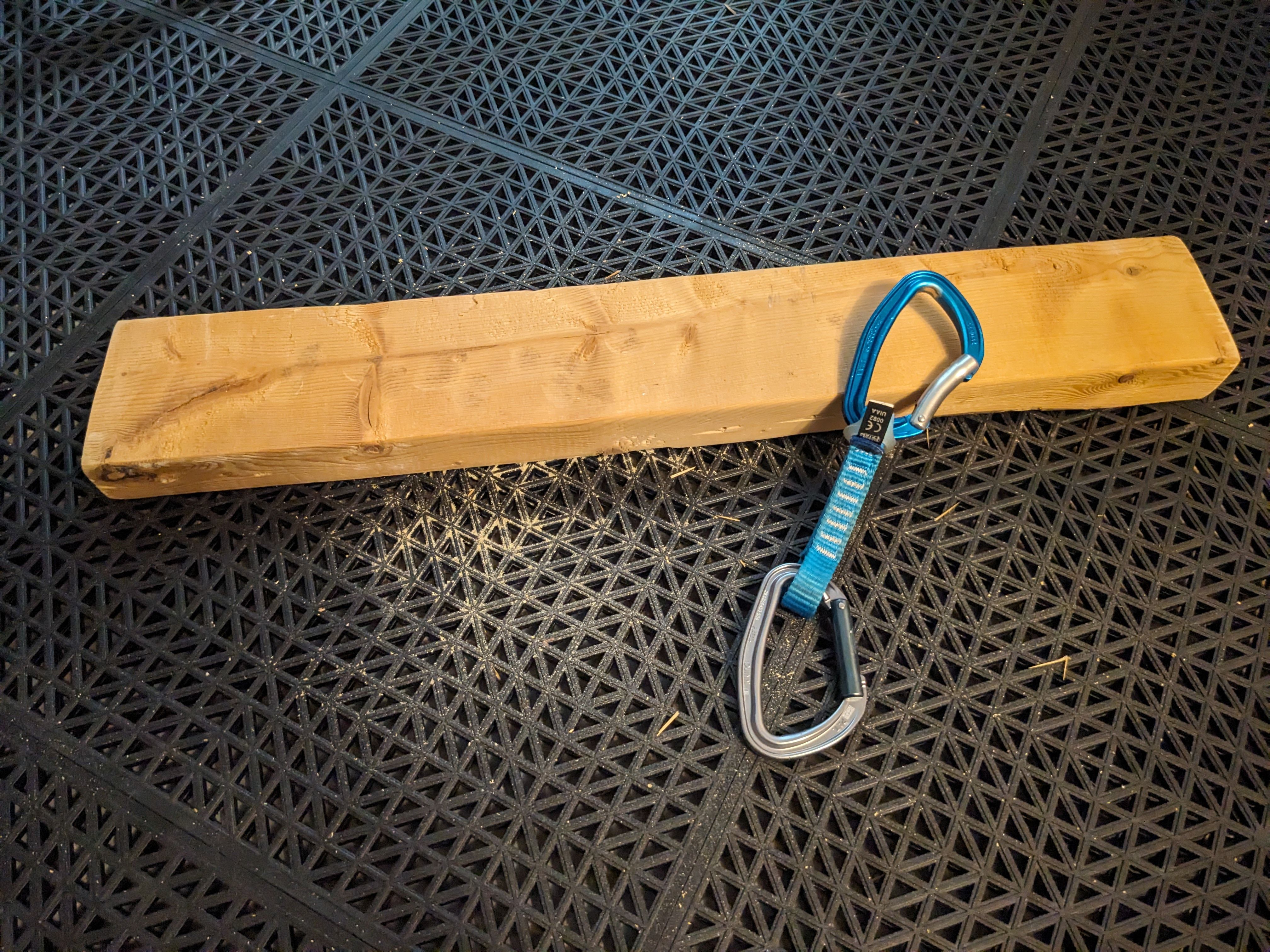
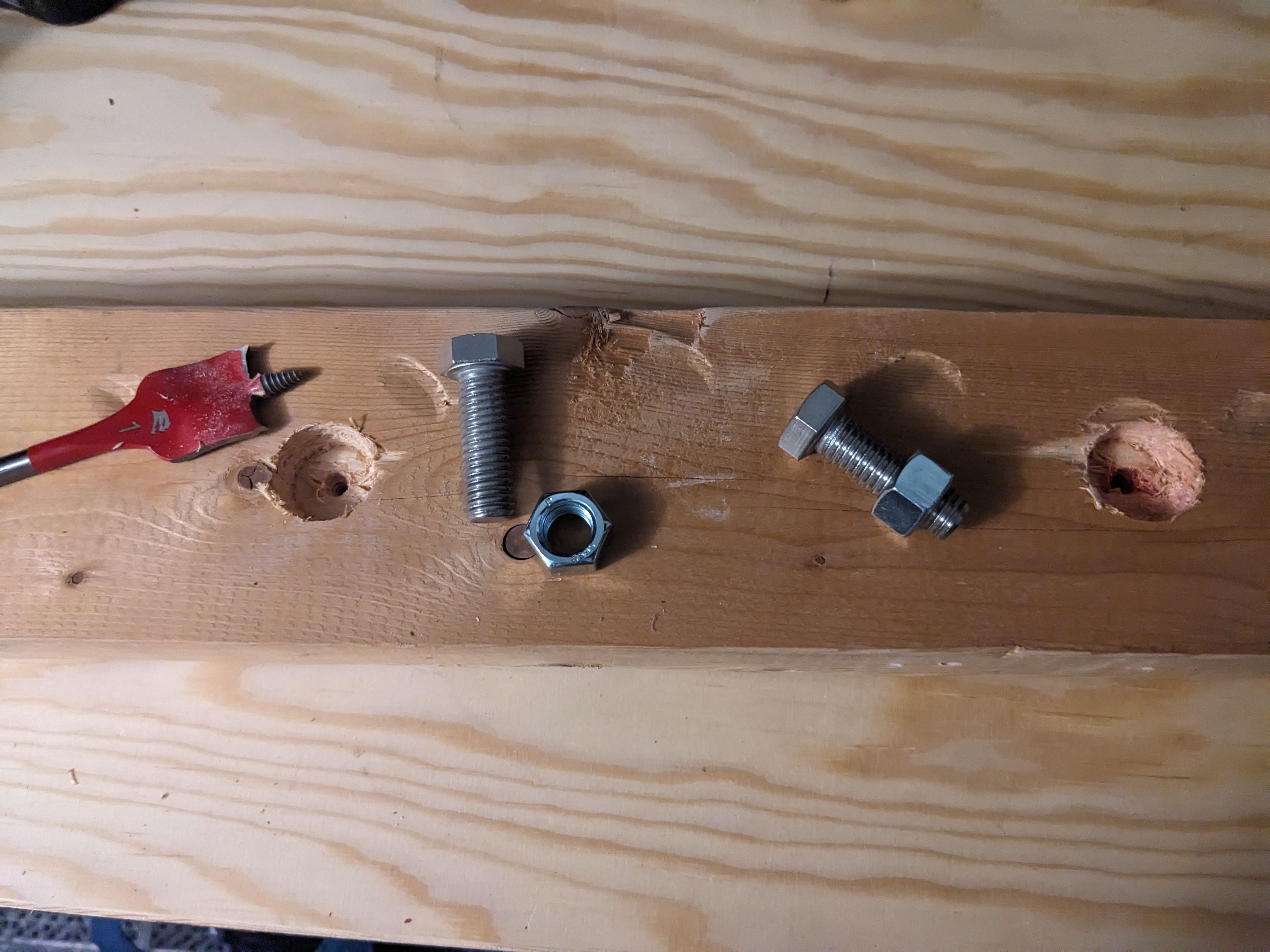
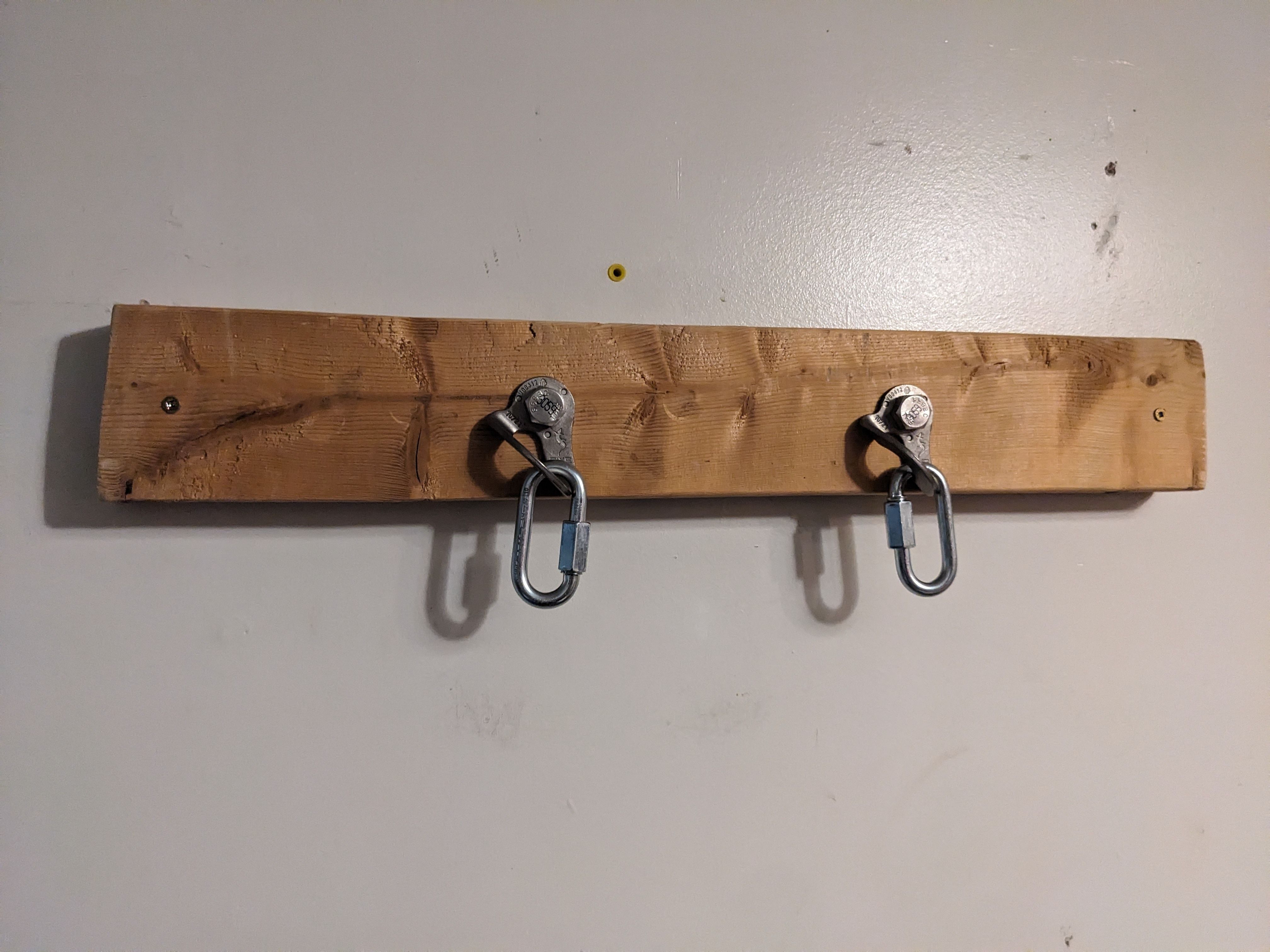
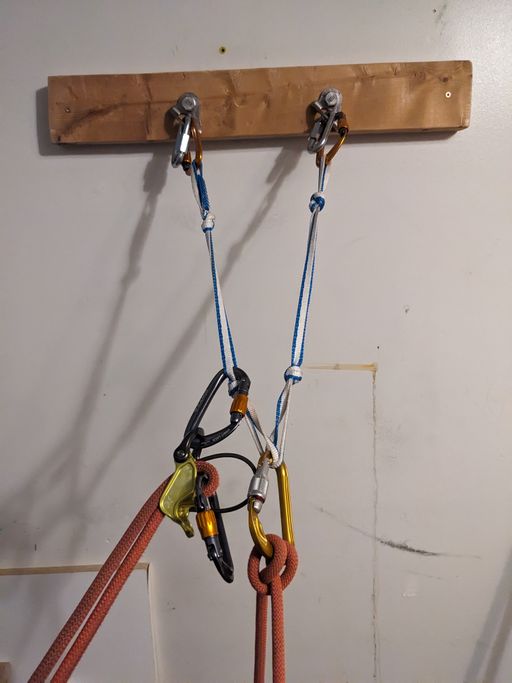
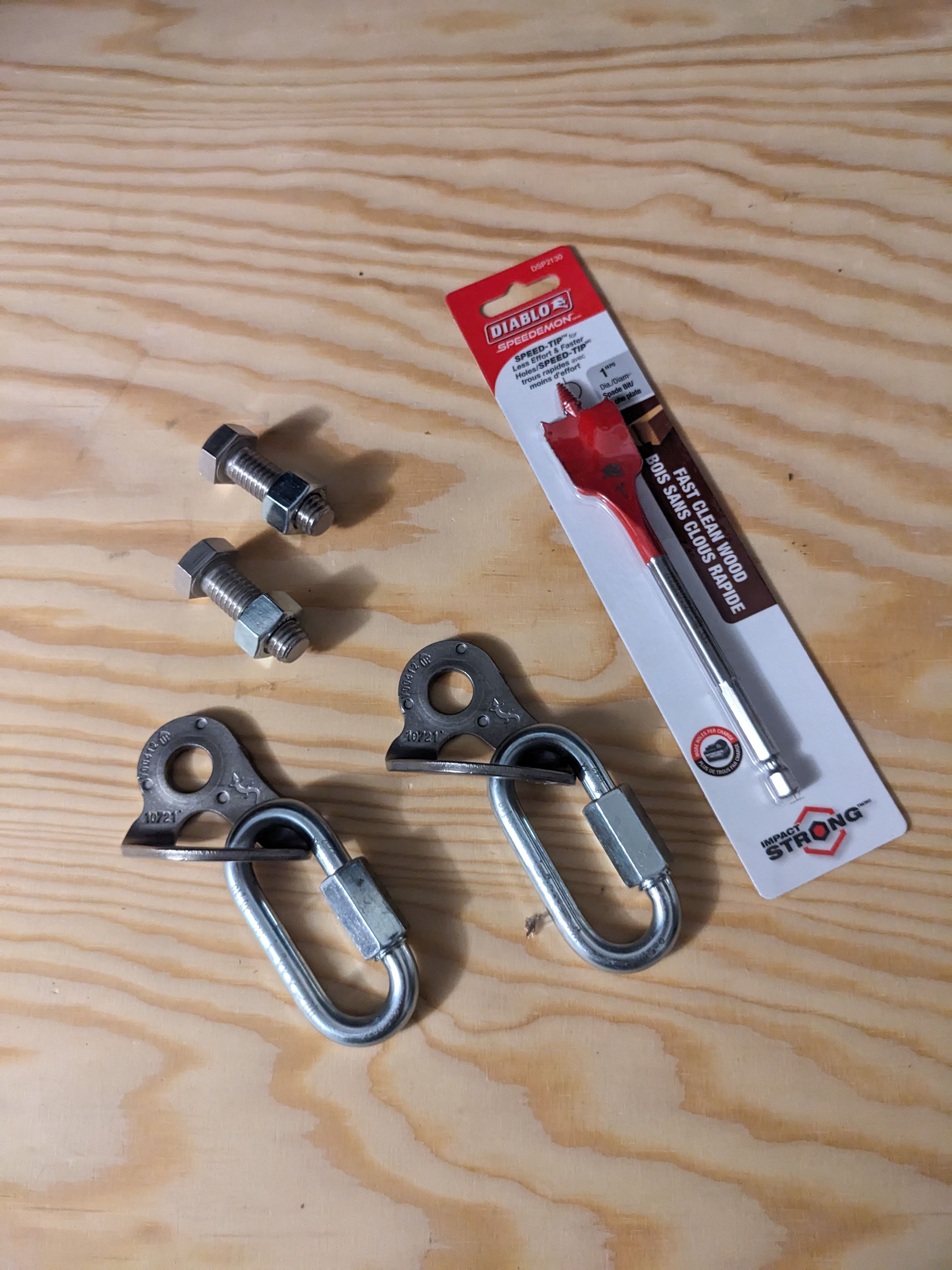
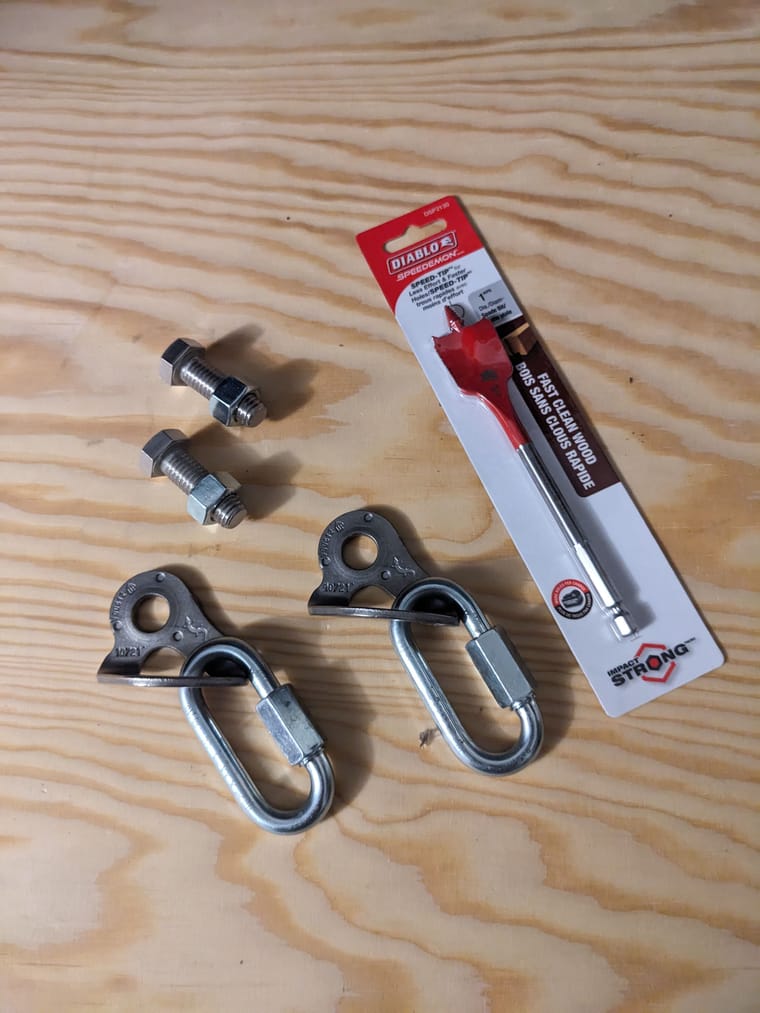
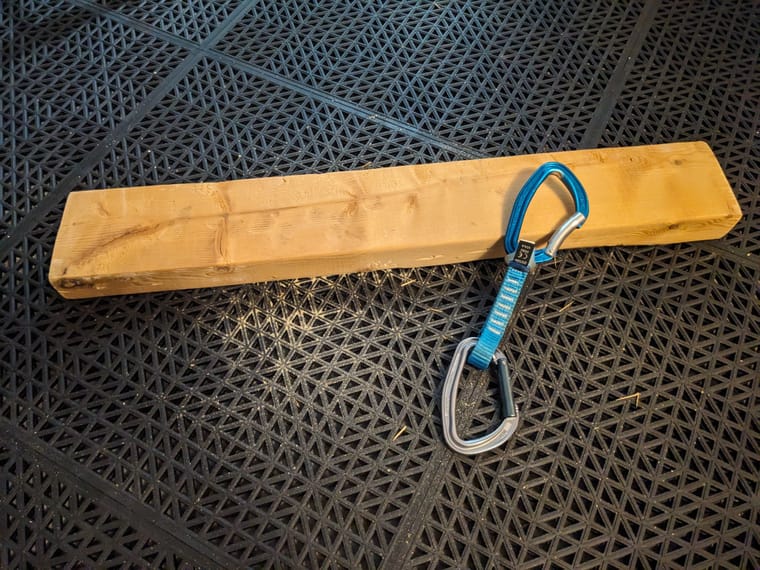
    After a quick trip to the hardware store, I got what I needed and as promised, here are some progress pics and the final result.
    PXL_20240822_143020828.jpg

    PXL_20240822_194756349.jpg

    PXL_20240822_204026195.MP.jpg

    PXL_20240823_021253567.jpg

    Some notes

    • The initial plan was to use tee nuts or threaded inserts, but I wasn't able to easily get those, so the fallback was to use regular nuts and to drill a recess into the back of the board so they'd sit flush.
    • There was some splintering the first time I tried to use a spade bit. Practice makes perfect!
    • I expected the studs in my garage to be 16 inches apart, but they were 21.5 inches. Measure twice, cut once!
    • I was today years old when I discovered a 2x4 is not 2 inches by 4 inches.

    Cost breakdown (Canadian dollars):

    • Fixe 316 SS Bolt Hanger 1/2" (MEC, $2.93 apiece)
    • Camp 8mm Oval Steel Quicklink (MEC, $4.95 apiece)
    • 1" spade bit ($8.98)
    • 1/2" threaded bolt ($3.85 apiece)
    • 1/2" nut ($0.26 apiece)
    • Free/on-hand items:
      • Scrap wood (2x4)
      • Power drill and drill bits
      • Adjustable wrench and socket wrench
      • Deck screws
    • Total: $32.96 CAD
  • Sweet! Have you tested it at all yet? Do you see any flex of you try to hang from it?

    Another idea might be just a piece of 2x4 screwed lower to the ground to act as a foothold while you're "on" the anchors

  • Okay, I did a thing.

    Yesterday I briefly outlined my plans to build a set of practice anchors in my garage.

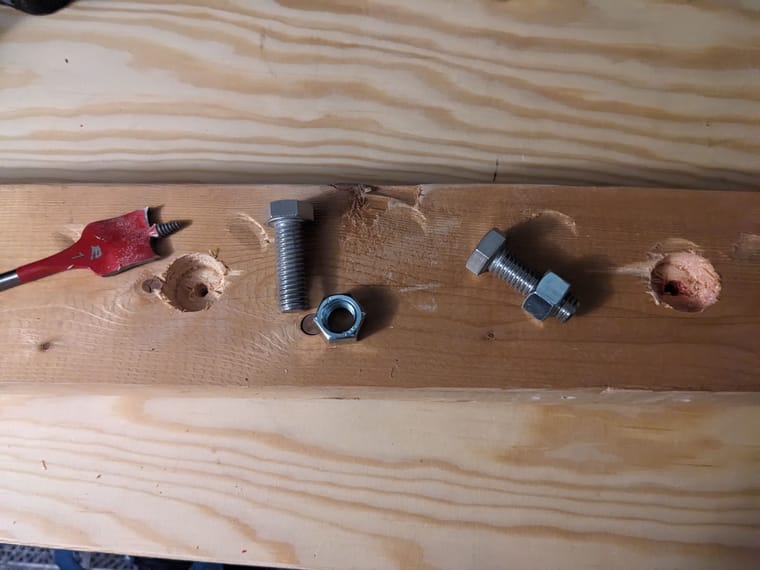
    After a quick trip to the hardware store, I got what I needed and as promised, here are some progress pics and the final result.
    PXL_20240822_143020828.jpg

    PXL_20240822_194756349.jpg

    PXL_20240822_204026195.MP.jpg

    PXL_20240823_021253567.jpg

    Some notes

    • The initial plan was to use tee nuts or threaded inserts, but I wasn't able to easily get those, so the fallback was to use regular nuts and to drill a recess into the back of the board so they'd sit flush.
    • There was some splintering the first time I tried to use a spade bit. Practice makes perfect!
    • I expected the studs in my garage to be 16 inches apart, but they were 21.5 inches. Measure twice, cut once!
    • I was today years old when I discovered a 2x4 is not 2 inches by 4 inches.

    Cost breakdown (Canadian dollars):

    • Fixe 316 SS Bolt Hanger 1/2" (MEC, $2.93 apiece)
    • Camp 8mm Oval Steel Quicklink (MEC, $4.95 apiece)
    • 1" spade bit ($8.98)
    • 1/2" threaded bolt ($3.85 apiece)
    • 1/2" nut ($0.26 apiece)
    • Free/on-hand items:
      • Scrap wood (2x4)
      • Power drill and drill bits
      • Adjustable wrench and socket wrench
      • Deck screws
    • Total: $32.96 CAD

    @devnull I got that on my to-do-list… One day it actually might happen 🤠 I got inspired by the SkillzBoard https://skillzboard.com

  • Okay, I did a thing.

    Yesterday I briefly outlined my plans to build a set of practice anchors in my garage.

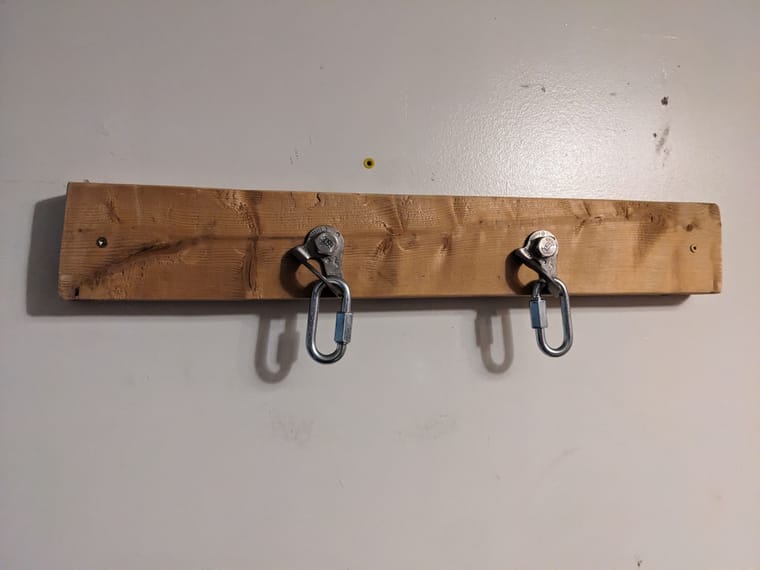
    After a quick trip to the hardware store, I got what I needed and as promised, here are some progress pics and the final result.
    PXL_20240822_143020828.jpg

    PXL_20240822_194756349.jpg

    PXL_20240822_204026195.MP.jpg

    PXL_20240823_021253567.jpg

    Some notes

    • The initial plan was to use tee nuts or threaded inserts, but I wasn't able to easily get those, so the fallback was to use regular nuts and to drill a recess into the back of the board so they'd sit flush.
    • There was some splintering the first time I tried to use a spade bit. Practice makes perfect!
    • I expected the studs in my garage to be 16 inches apart, but they were 21.5 inches. Measure twice, cut once!
    • I was today years old when I discovered a 2x4 is not 2 inches by 4 inches.

    Cost breakdown (Canadian dollars):

    • Fixe 316 SS Bolt Hanger 1/2" (MEC, $2.93 apiece)
    • Camp 8mm Oval Steel Quicklink (MEC, $4.95 apiece)
    • 1" spade bit ($8.98)
    • 1/2" threaded bolt ($3.85 apiece)
    • 1/2" nut ($0.26 apiece)
    • Free/on-hand items:
      • Scrap wood (2x4)
      • Power drill and drill bits
      • Adjustable wrench and socket wrench
      • Deck screws
    • Total: $32.96 CAD

    @devnull I would recommend adding washers to those nuts to prevent them from digging into the wood over time, and 4 screws on the corners to prevent the board rocking when loaded/unloaded.

    Not the typical reunion but I guess it works for simple practice.

    I would tottally do something like that if I was allowed to in any case.

    This is how it starts, and it ends with a climbable wall in the garage xD It's a matter of time.

  • @devnull I would recommend adding washers to those nuts to prevent them from digging into the wood over time, and 4 screws on the corners to prevent the board rocking when loaded/unloaded.

    Not the typical reunion but I guess it works for simple practice.

    I would tottally do something like that if I was allowed to in any case.

    This is how it starts, and it ends with a climbable wall in the garage xD It's a matter of time.

    @rayko@mastodon.raykoworld.com ah that's good advice! Ironically the weakest part of this board is the actual attachment to the studs.

    I need to buy longer screws and put four more. That'll be "super good enough" hopefully, as a certain someone says.

    @bean no flex, although I also haven't fully weighted the board just yet. I've only practiced a top belay setup so far.

  • @devnull I got that on my to-do-list… One day it actually might happen 🤠 I got inspired by the SkillzBoard https://skillzboard.com

    @martinsnygg@infosec.exchange

    SkillzBoard

    Ha! Yeah I did see this before too. It was probably also where the idea first took hold in my head.

    I put in two hangers but I think eventually I'll have to add a third when testing more esoteric three-piece setups 😬

    Maybe I'll build a little crack to hold a cam...

  • @martinsnygg@infosec.exchange

    SkillzBoard

    Ha! Yeah I did see this before too. It was probably also where the idea first took hold in my head.

    I put in two hangers but I think eventually I'll have to add a third when testing more esoteric three-piece setups 😬

    Maybe I'll build a little crack to hold a cam...

    @devnull And so the scope creep begins hehe

  • @martinsnygg@infosec.exchange

    SkillzBoard

    Ha! Yeah I did see this before too. It was probably also where the idea first took hold in my head.

    I put in two hangers but I think eventually I'll have to add a third when testing more esoteric three-piece setups 😬

    Maybe I'll build a little crack to hold a cam...

    @devnull Yeah, three is a must for me I think to get a grip on equalization and stuff. Not really sure I do need a board though. Might just put up three hangers on a beam in the basement.

  • Today's faffery — Garda hitch shenanigans

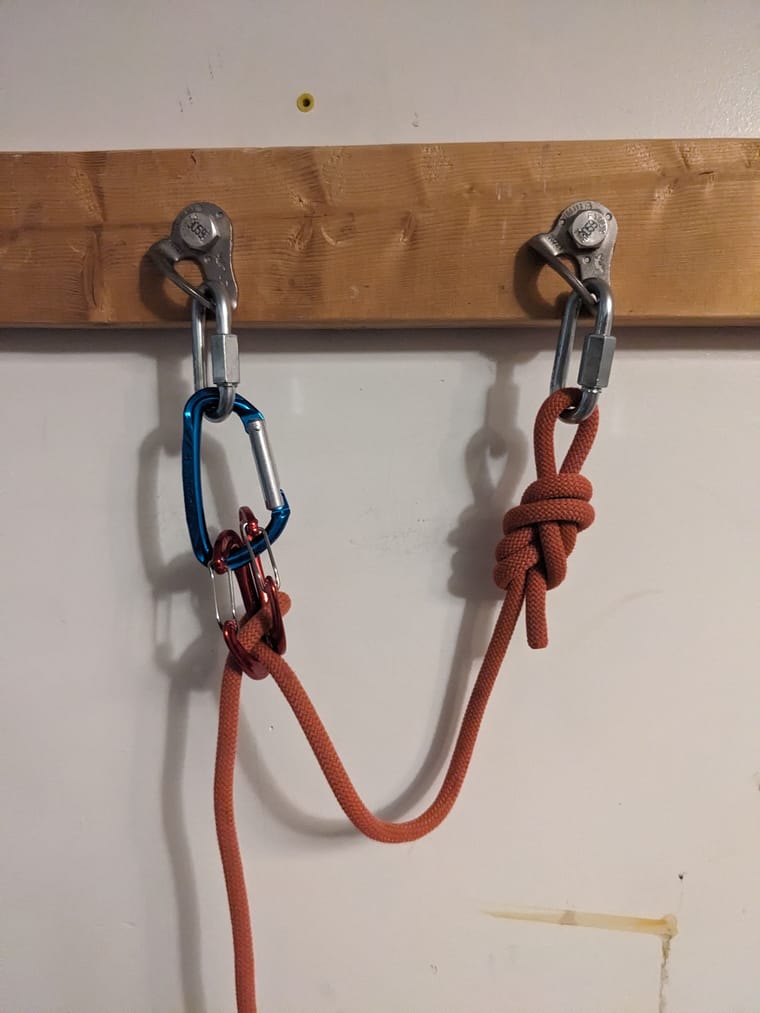
    Want a solution to a super contrived scenario whereby you have no belay device or HMS carabiner (for a munter hitch), but do have two non-locking carabiners and still want to haul something up with a makeshift progress capture device?
    1000004639.jpg

  • Today's faffery — Garda hitch shenanigans

    Want a solution to a super contrived scenario whereby you have no belay device or HMS carabiner (for a munter hitch), but do have two non-locking carabiners and still want to haul something up with a makeshift progress capture device?

    1000004639.jpg

    @devnull
    Funnily, #HowNot2 just shared a video a couple of days ago about tests he did with the #GardaHitch.

  • @devnull
    Funnily, #HowNot2 just shared a video a couple of days ago about tests he did with the #GardaHitch.

    @mkroehnert@social.tchncs.de indeed, that video is exactly why I even played around with it 😁

    So now one more esoteric tool in my quiver.
Suggested topics


  • Prescription—High Altitude Cerebral Edema

    General News climbing
    1
    5 Votes
    1 Posts
    105 Views
    American Alpine ClubA
    Every year we publish several accounts of high altitude pulmonary edema and high altitude cerebral edema. While most of these incidents in North America occur in the Alaska Range, any terrain above 10,000 feet holds altitude hazards. Most cases are resolved by descending immediately upon the appearance of symptoms. But as you’ll read below, last spring on Denali, bad weather delayed a rescue helicopter, and by the time the climber was evacuated, it was too late. On May 30, 2024, an independent expedition at 14,200-foot camp notified rangers via radio that one member of their team, a 24-year-old Coloradan, had an altered mental status. The patient’s team stated that they had been dropped off by plane at base camp (7,200 feet) on May 27. Immediately upon landing, the team departed for the West Buttress Route, reaching 14,200-foot camp a day and a half later, on the evening of May 28. The team stated that upon reaching camp, all team members were feeling “OK.”  On the afternoon of May 30, teammates alerted NPS rangers that the Coloradan—after reportedly feeling “groggy” with a slight headache—began exhibiting severe symptoms of high altitude cerebral edema (HACE) and high altitude pulmonary edema (HAPE). A second team member was experiencing moderate symptoms of HAPE. Weather conditions did not allow helicopter flights on the night of May 30. A team of NPS rangers and volunteer patrol members performed 18 hours of advanced life support on the unresponsive HACE/HAPE patient throughout the night, including treatment in a hyperbaric chamber, medications, supplemental oxygen, and mechanical breathing assistance. On the morning of May 31, the patient was evacuated by helicopter with an Air National Guard Pararescue Specialist from the 212th Rescue Unit serving as the medical attendant. The patient was flown to Talkeetna and transferred to a LifeMed air ambulance for advanced care. Unfortunately, the patient succumbed to the effects of HACE/HAPE in the hospital. As many do, this team made the assumption that living at a relatively high altitude (over 5,000 feet) and maintaining a high level of fitness would prepare them adequately for swift elevation gain. This is a severe example of the inaccuracies of this assumption. Living at altitude and having good fitness are not guaranteed to protect climbers against high altitude illness (HAI). The human body starts losing adaptations to altitude in a matter of days, which is often the amount of time that climbers spend traveling to Alaska to begin an expedition. The Wilderness Medicine Society (WMS) recommends that, at elevations above 9,000 feet, climbers ascend no more than 1,650 feet (500 meters) to a new sleeping elevation each night. Additionally, for every 3,300 feet (1,000 meters) of elevation gain, the WMS recommends spending an extra day sleeping at a given elevation to further acclimatize. The mountaineering rangers on Denali see many very fit climbers arriving to attempt a summit each season. Although fitness is an important factor in risk management and safe travel on the mountain, it can also make the recommended conservative ascent profile feel onerous. Unfortunately, a climber’s level of fitness has no correlation with whether or not they become stricken with HAI. Only a reasonable ascent profile and proper acclimatization will prevent climbers from becoming ill. (Source: Denali Mountaineering Rangers.) https://americanalpineclub.org/news/2025/4/3/prescriptionhape-hace
  • The Height of Mountains

    General News climbing
    1
    0 Votes
    1 Posts
    130 Views
    American Alpine ClubA
    Originally published in Guidebook XIII Eric Gilbertson was on the summit of Rainier. Or was he? With the differential GPS set up in front of him, he hopped from foot to foot—it was cold up there, but he was also anxious to confirm his suspicions by applying a more rigorous measuring process to the changes he could see with the naked eye. Funded by the AAC Research Grant, he had used an Abney level to measure the relative heights of Columbia Crest, the traditional icecap summit of Rainier where he stood now, as compared to the actual highest point in the summit area—the southwest edge of the crater rim, which was a rock outcrop. Based on the Abney level, Columbia Crest was distinctly shorter than the southwest rim. With calculations spinning in his head, he noticed the unmistakably dirtier, more trampled quality of Columbia Crest, the way dirt and rocks seemed to muddle the pure snow dome, bringing a wilted quality to the landscape, especially compared to what he could remember seeing in old photographs of Rainier’s summit. He would have to wait to process the data from the differential GPS to be sure exactly by how much the summit had changed. Yet more than the relief of seeing his hypothesis likely confirmed, a bigger question loomed: Were mountains, which so many consider the stalwart indicator of the unmoving, the unchanging, the steady, actually shrinking? And what would it mean if they were? Eric Gilbertson is a man of many lists and projects. Each of his projects coalesces around peakbagging, and now surveying. The idea to research the current heights of the five remaining icecap peaks in the Lower 48, which includes Rainier, started when Mt. St. Helens eroded off the top 100 highest peaks of Washington list. Gilbertson had discovered that St. Helens had been steadily eroding by four inches each year since 1989, and because of that, St. Helens had technically fallen off the top 100 list around 2021. As an exacting, rigorous person who prizes accuracy above all in his life’s work, Gilbertson was intrigued—were there more discrepancy in the heights of the other top 100 Washington mountains? If his goal was to do all the hundred highest, and be the first to do them all in winter no less, he wanted to do it right. Before fact-checking the hundred highest list, before measuring the status of the five historical icecap peaks of the Lower 48, Eric and his brother Matthew had been pursuing what they called “The Country High Points Project.” Though the brothers are each respected alpinists in their own right, with several technical first ascents and inclusions in the American Alpine Journal to Eric’s name, they are peakbaggers at heart. Which is why they conceived of the project to get to the highest point of every country in the world, as defined by UN members and observer states, plus Antarctica. Thus, there are 196 highpoints on their list. So far, Eric has gotten to the highest point of 144 countries and Matthew has ticked 97. Eric says he sees the project as a framework for creating opportunities for really interesting adventures. “[It] kind of requires every kind of skill set you can imagine. It definitely requires high-altitude mountaineering, like K2 is on there and Everest, but it also requires jungle bushwhacking in the Caribbean or hiking through the desert in Chad. There is so much red tape you have to get through—like in West Africa there are so many police checkpoints so you have to navigate those—so many languages you have to speak, logistics to make it interesting, and the other interesting aspect is [sometimes we don’t know which] is the highest mountain, so in comes the survey equipment.” When, in 2018, the brothers determined the highest point in Saudi Arabia had actually been misunderstood all along, Eric became particularly interested in exactness and discovery, and how these elements added an interesting complexity to getting to the great heights of the world. A lot more was unknown than one might first imagine, given our information-overload culture. Not knowing if the mountain you were climbing was even the highest point in the country added a challenge that seemed to surpass even first ascenting. Yet Eric is not always flitting across to the farthest reaches of the world. As an associate teaching professor at Seattle University, he is rooted a good portion of the year, so he is constantly finding ways to feed his passion for discovery and peakbaggi... https://americanalpineclub.org/news/2025/2/10/guidebook-xiii-researchgrant
  • The Line: A Great Year for Women in the Mountains

    General News climbing
    1
    0 Votes
    1 Posts
    111 Views
    American Alpine ClubA
    All-women teams have been exceptionally active around the world this year. This month we’re highlighting two of them: a Slovenian women’s expedition to Zanskar, India, and an Italian pair in the Pamir Alai of Kyrygzstan. Two other highly ambitious expeditions in 2024 involved American women: Chantel Astorga, supported by an AAC Cutting Edge Grant, nearly completed a new route up Shivling in India with Fanny Schmutz; and Michelle Dvorak, armed with a McNeill-Nott Grant, got high on the unclimbed southeast buttress of Chaukhamba III, also in India, with Fay Manners, before a rockfall incident forced them down. Just this month, Babsi Zangerl made her extraordinary flash of an El Cap free route. Plenty more women’s climbs will appear in the 2025 AAJ: See the gallery above for a little preview! Our all-female expedition to Zanskar, India, was comprised of Ana Baumgartner, Urša Kešar, Patricija Verdev, and me (all from Slovenia). On August 26, we left the road with 18 porters to climb in the Lalung Valley. Our main goal was Lalung I and neighboring peaks. The day after our arrival at base camp, we explored higher up the valley. It took an entire day to make a 20-kilometer round trip on moraine and glacial terrain, and, as the weather was poor, we didn’t see much of the higher peaks. On August 31, Patricija and I climbed a new route on a granite north-northwest face not far from base camp. This buttress, which starts at around 4,200 meters, lies on the south side of the valley and rises to Peak 5,346m. One route had been climbed previously near the center of this face, by Indians Korak Sanyal and Spandan Sanyal (see AAJ 2018). Our new route, Connection (VI-), took 15 hours and involved around 1,400 meters of climbing. Before moving up to an advanced base camp, we had a nighttime visit from a bear. It was an unpleasant encounter, with the animal sniffing around our tents for food. All four climbers were happy to relocate to a bear-free advanced base at 4,800 meters. Urša had difficulties with the altitude, however, so after a couple of days she and Ana returned to base camp, where they and our cooks and liaison officer had to deal with a full-on bear saga. After more than 10 nighttime bear visits, resulting in Patricija’s tent being ripped, heaps of food stolen, and the toilet tent demolished, they managed to scare off the bears with fire and enjoy a few peaceful nights. During this period, Urša and Ana climbed two more new routes on the north-northwest face of Peak 5,332m, finishing on the northwest ridge. Meanwhile, on September 9, Patricija and I left advanced base for the east ridge of unclimbed Lalung I (6,243m), camping a little way above the start. We’d had a forecast for a good weather window, but a snowstorm on the 10th forced us to set up tent in the middle of the day and sit out the bad weather. The storm lasted all the next day, but the 12th dawned clear and we climbed late into the night. Day five on the ridge required even more determination, and it wasn’t until 1:30 a.m. that we settled down for a rest, having climbed the final difficult mixed pitches. In a moment of carelessness brought on by fatigue, we lost our tent poles to the wind and slept in the open in bivouac sacks. The next morning was foggy, making it hard to navigate, but after some snow slopes, we reached the summit at 9 a.m. on the 14th. We proceeded with a long descent along the west ridge and then five rappels on the north face to reach the glacier at 6:30 p.m. It took another eight hours to reach advanced base. Next day, we descended to base camp. Just before stepping off the moraine, we saw three silhouettes, Ana, Urša, and Freni, who brought smiles to our tired faces. We named our route Here Comes the Sun (M6+ AI5+, with around 2,000 meters of climbing). — Anja Petek, Slovenia Camilla Reggio and I met on the Eagle Team of the Italian Alpine Club (CAI) and immediately became friends, connected by our huge passion for the mountains. We decided to plan our first expedition together and ended up in Kyrgyzstan, with the intent of climbing on the incredible granite of the Ak-su Valley in the Pamir Alai mountains. We hoped to open a new route.  Walking up and down the valley in search of possible lines, we were impressed by the 500m south face of Pik 3,850m (a.k.a. the south buttress of Pik Slesova). The following morning, August 12, we brought a... https://americanalpineclub.org/news/2024/11/17/the-line-a-great-year-for-women-in-the-mountains
  • Don’t Miss the Brit Rock 6 Canadian Film Tour

    General News climbing
    1
    0 Votes
    1 Posts
    103 Views
    GrippedG
    This year's tour includes three awesome films featuring El Capitan, Devils Tower, and Switzerland The post Don’t Miss the Brit Rock 6 Canadian Film Tour appeared first on Gripped Magazine. https://gripped.com/news/dont-miss-the-brit-rock-6-canadian-film-tour/
  • Want to Send Your Project? Be Willing to Walk Away.

    General News climbing
    1
    0 Votes
    1 Posts
    103 Views
    climbingC
    When working on limit projects, it’s too easy for “failure” to feel “safe.” To maximize his performance, Brian Stevens decided to try adding stakes. https://www.climbing.com/skills/sport-climbing/quitting-projecting-motivation/
  • Interview James Pearson on his repeat of Echo Wall

    General News climbing
    1
    0 Votes
    1 Posts
    90 Views
    UK ClimbingU
    https://www.ukclimbing.com/forums/t.php?n=773875
  • Paris 2024 Olympics - Men’s Bouldering Semi-final

    General News climbing
    1
    0 Votes
    1 Posts
    93 Views
    climber-magazineC
    Anraku, Naraski and Roberts are the top three finishers in the men’s Boulder semi-final on climbing's opening day at the Paris 2024 Olympic Games. https://www.climber.co.uk/news/paris-2024-olympics-men-s-bouldering-semi-final/
  • Catching Bouldering Vibes in Fontainebleau

    General News climbing
    1
    0 Votes
    1 Posts
    86 Views
    GrippedG
    A group of competition climbers look to escape indoor spaces in a new film that just dropped The post Catching Bouldering Vibes in Fontainebleau appeared first on Gripped Magazine. https://gripped.com/news/catching-bouldering-vibes-in-fontainebleau/