Skip to content

Double Spoc; top rope solo

General Climbing
10 4 665 1
  • Not sure how active the rope solo scene is on fedi, but I figure I'd ask.

    There's been quite a bit of discussion over the years about various systems, but the modern consensus seems to be to use two progress capture devices on a single (or dual) fixed line, with one suspended higher than the other via use of a neck strap or chest harness.

    By far (at least in North America) the consensus seems to be to use the Petzl Microtraxion.

    The Edelrid Spoc seems to be a good alternative, is both lighter and cheaper, and is also mentioned occasionally in discussions about TRS.

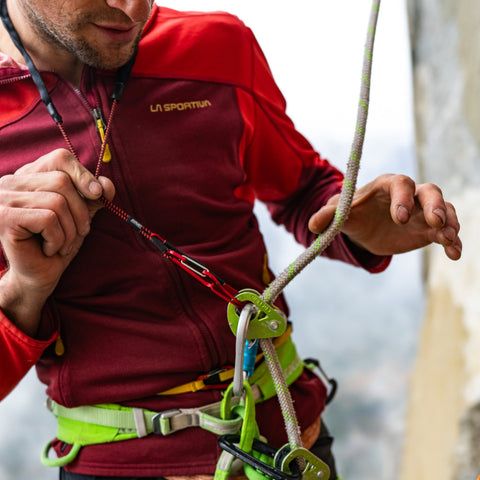
    Brent Barghahn is seen in this photo in a double-Spoc setup:
    1000006397.jpg

    Any potential problems I should be considering?

  • Not sure how active the rope solo scene is on fedi, but I figure I'd ask.

    There's been quite a bit of discussion over the years about various systems, but the modern consensus seems to be to use two progress capture devices on a single (or dual) fixed line, with one suspended higher than the other via use of a neck strap or chest harness.

    By far (at least in North America) the consensus seems to be to use the Petzl Microtraxion.

    The Edelrid Spoc seems to be a good alternative, is both lighter and cheaper, and is also mentioned occasionally in discussions about TRS.

    Brent Barghahn is seen in this photo in a double-Spoc setup:

    1000006397.jpg

    Any potential problems I should be considering?

    This post is deleted!
  • This post is deleted!

    This post is deleted!
  • Not sure how active the rope solo scene is on fedi, but I figure I'd ask.

    There's been quite a bit of discussion over the years about various systems, but the modern consensus seems to be to use two progress capture devices on a single (or dual) fixed line, with one suspended higher than the other via use of a neck strap or chest harness.

    By far (at least in North America) the consensus seems to be to use the Petzl Microtraxion.

    The Edelrid Spoc seems to be a good alternative, is both lighter and cheaper, and is also mentioned occasionally in discussions about TRS.

    Brent Barghahn is seen in this photo in a double-Spoc setup:

    1000006397.jpg

    Any potential problems I should be considering?

    @devnull
    In general, or specific to the devices?

    Note, I only read/watched information on TRS.

    Regarding devices in general, the most crucial things seem to be carabiner cross loading and devices getting unblocked.

    Regarding general aspects it makes sense to analyse all steps that could fail and check for mitigations.
    Like is doing in their Lead Rope Solo risk analysis video (https://www.youtube.com/watch?v=mTTDRX6RTWc).
    But I think more details could/should be included.

  • @devnull
    In general, or specific to the devices?

    Note, I only read/watched information on TRS.

    Regarding devices in general, the most crucial things seem to be carabiner cross loading and devices getting unblocked.

    Regarding general aspects it makes sense to analyse all steps that could fail and check for mitigations.
    Like is doing in their Lead Rope Solo risk analysis video (https://www.youtube.com/watch?v=mTTDRX6RTWc).
    But I think more details could/should be included.

    @devnull

    For cross loading, you might have seen the latest video by Yann Camus already
    https://www.youtube.com/watch?v=WXVF5zmPt_I

    And for other risks to consider, there is also the episodes on Top Rope Solo and Lead Rope Solo.

  • @devnull

    For cross loading, you might have seen the latest video by Yann Camus already
    https://www.youtube.com/watch?v=WXVF5zmPt_I

    And for other risks to consider, there is also the episodes on Top Rope Solo and Lead Rope Solo.

    @mkroehnert@social.tchncs.de I actually hadn't seen the latest video Yann put out, so that'll be on the list tonight!

    @HowNOT2's video is actually how I got interested in TRS in the first place! Really good and straightforward explanation of the mechanisms and risks involved.

  • This post is deleted!

    @pmonks@sfba.social @mkroehnert@social.tchncs.de That's a good list, although your two thoughts ended up being six 😆

    I've thought a bit about the idea of using two different devices. I was about to pull the trigger on a CAMP Lift, but I wasn't convinced of its safety given its tendency to no longer engage when grabbed or tilted (against a rock perhaps?) — additionally most rope soloists who climb with progress capture devices (again, talking North America) seem to go with the double-trax, which also doesn't satisfy the "two different devices" constraint.

    I will have an ascender (a tibloc + PAS) and a descender (Mammut Smart).

    As for rope protection, I was planning on re-fixing often so as to not worry (too much) about edge protection.

    Lastly, will be running all of this on my garage anchor board to get all these new skills (and devices!) tested for real before I get out on rock!

  • @mkroehnert@social.tchncs.de I actually hadn't seen the latest video Yann put out, so that'll be on the list tonight!

    @HowNOT2's video is actually how I got interested in TRS in the first place! Really good and straightforward explanation of the mechanisms and risks involved.

    @devnull
    I forgot, that has a collection of articles regarding Toprope solo.
    Including a non exhaustive list for risk analysis.

    You can find them at the end of the following page, where the first article is called 'To read for self-belaying'
    https://www.petzl.com/US/en/Sport/Indoor-and-Outdoor-Climbing

  • Not sure how active the rope solo scene is on fedi, but I figure I'd ask.

    There's been quite a bit of discussion over the years about various systems, but the modern consensus seems to be to use two progress capture devices on a single (or dual) fixed line, with one suspended higher than the other via use of a neck strap or chest harness.

    By far (at least in North America) the consensus seems to be to use the Petzl Microtraxion.

    The Edelrid Spoc seems to be a good alternative, is both lighter and cheaper, and is also mentioned occasionally in discussions about TRS.

    Brent Barghahn is seen in this photo in a double-Spoc setup:

    1000006397.jpg

    Any potential problems I should be considering?

    I use microtraction, an old ushba and a homemade neck/elastic loop. Works fine. Ushba is primary, micro traction is secondary. Very smooth. Pay close attention to how your system performs in overhanging terrrain.
  • Not sure how active the rope solo scene is on fedi, but I figure I'd ask.

    There's been quite a bit of discussion over the years about various systems, but the modern consensus seems to be to use two progress capture devices on a single (or dual) fixed line, with one suspended higher than the other via use of a neck strap or chest harness.

    By far (at least in North America) the consensus seems to be to use the Petzl Microtraxion.

    The Edelrid Spoc seems to be a good alternative, is both lighter and cheaper, and is also mentioned occasionally in discussions about TRS.

    Brent Barghahn is seen in this photo in a double-Spoc setup:

    1000006397.jpg

    Any potential problems I should be considering?

    This post did not contain any content.
Suggested topics


  • 0 Votes
    1 Posts
    18 Views
    Sebastiaan Ammerlaan 🇳🇱B
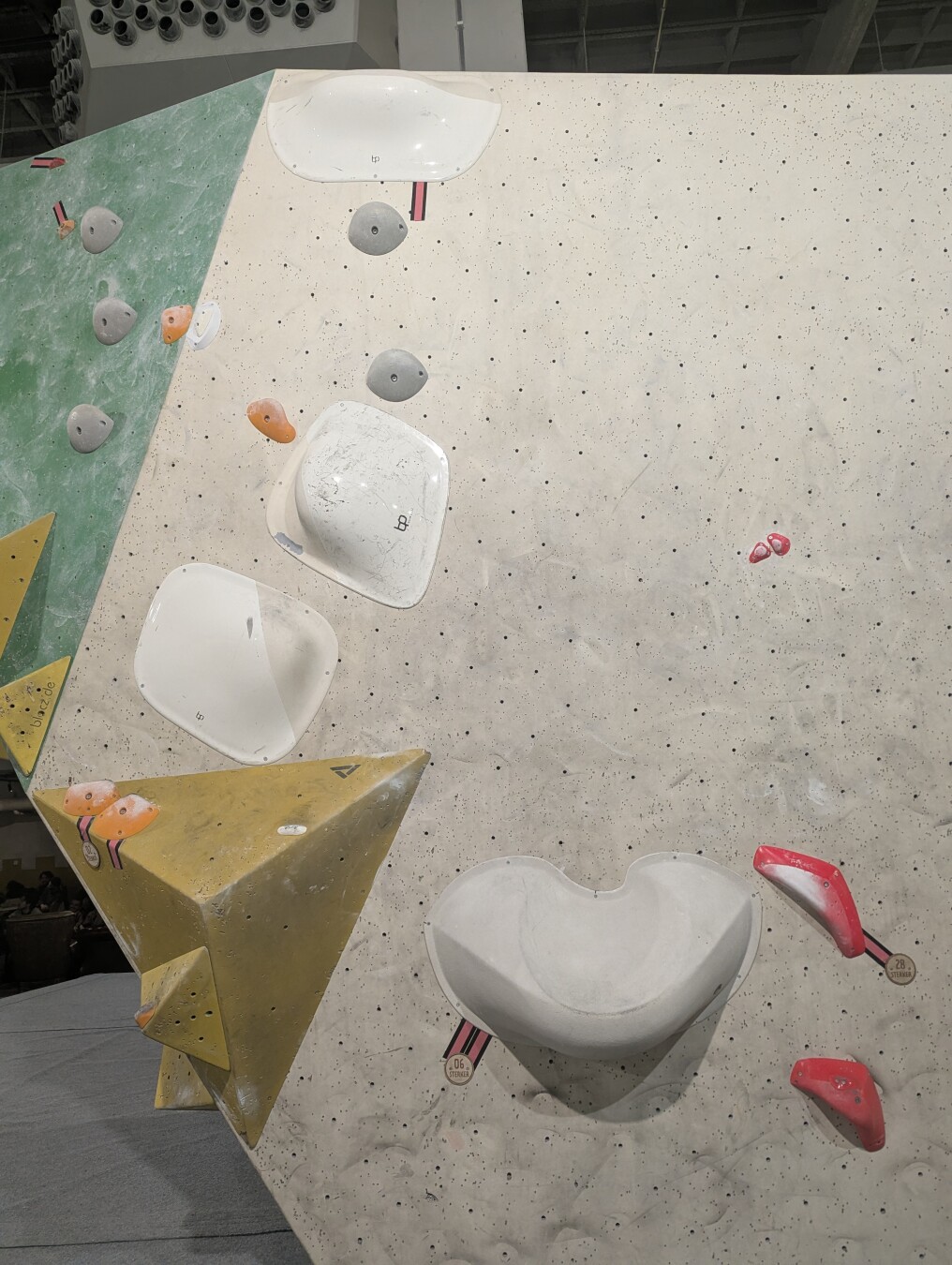
    Joined my first bouldering competition today! Didn't score very high, but that's fine. Did manage to get some tricky ones. I was especially happy with this white and black one #bouldering #Sterk #SterkUtrecht promote#Utrecht #competition #climbing #RockClimbing
  • 0 Votes
    1 Posts
    91 Views
    American Alpine ClubA
    I move, therefore I am. I reminded myself of this throughout the journey to and from Arviqtujuq Kangiqtua, formerly known as Eglinton Fjord. Throughout our five-week, multi-sport, primarily human-powered expedition to Baffin Island, in the Canadian Arctic, Kelly Fields, Shira Biner, Natalie Afonina, and I continued to move. We skied over 100 miles across the sea ice in order to get there, and we slogged for another 100 miles over moraine fields, loose talus, sinking meadows, a frozen lake, and a partially frozen river to get out. Movement was our rule, our rhythm. And as a team of three women and a non-binary person, we were motivated to define this movement on our own terms. Kelly, Shira, Natalie, and I met for the first time in person at the Ottawa Airport en route to the Arctic. Only a few of us had tied in together before this trip. Prior to our real-life introduction, we spent months exchanging messages, photos, screenshots, videos, and group calls on WhatsApp. Now, past the logistical chaos of prep for this expedition, we still had a lot of learning to do about each other. I’m lucky in that I know an abundance of female, non-binary, and queer people who are incredible climbing partners. I prefer to rope up with them because of my ongoing struggles with self-confidence and self-trust that I learned in the shadow of my male climbing partners. Here was an opportunity to move toward my goals and the style of climbing that most inspires me, alongside a group of people who uplift one another. When we received our first grant—the McNeill-Nott Award from the American Alpine Club—I started to feel that other people believed in us, which gave me more belief in myself. Representation is important, and the organizations that supported us believed that too. It was coming together all too perfectly. I stared at the vast ice and seascape before me: Circles of white interrupted the piercing blue water that settled up to a foot deep in some places. We were leaving the bay in the small Inuit community of Clyde River. The gray sky let go of gentle snowflakes that melted on my sunglasses, making my surroundings appear as if I were looking out a window on a rainy day. “So...how thick is this ice?” I asked, my voice wavering. The last time I had put skis on was a number of years ago. On snow, on solid ground. However, I was soon submerged within and captivated by the ice’s symphony as we glided, heaved, soared over, walked, and trudged—depending on the conditions of the sea ice—over a hundred miles on a seascape that was constantly changing. Moving through that environment was dictated by the wind, temperature, snow, and our bodies’ needs. One moment, we would be trapped in a cloud, the snow absorbing the sound around us and sticking to our ski skins so thick that we had to take them off. Moments later, after turning a corner, the winds had blown the clouds and snow off the surface, and we found ourselves flying over the best ice conditions we had yet experienced. That landscape spoke to me, telling me that it, too, exists in states of movement and change. I often look to the natural world to find my own sense of belonging. Being a non-binary person often means that I don’t always find a type of belonging that is representative. I struggle in groups of men. In groups of women, I push back on the definitions and create an exclusionary space for myself. Asking for a non-binary category creates the exact thing I don’t want to exist within: a category. One day, I hope I can exist in a way that is outside the confines of man or woman—that I can exist as myself without needing to choose between explaining and educating, or quietly disrespecting myself. The thing about gender, being non-binary specifically, is that it’s simultaneously the most painful and most beautiful experience one can have. There is a deep gratitude in being the truest form of yourself; there is a wholeness in accepting one’s authenticity. It can also often be painful to a core level. My relationship with gender is like the Arctic wind: always present, sometimes gentle and caressing, other times a chaos that threatens to knock me down. I felt the spirits skiing into Arviqtujuq Kangiqtua. Finally, among those great walls, exhausted, hungry, sore, and cold, we debated where to set up our base camp and had a hard time getting anywhere productive with it. I remember feeling confused about how I could be in the greatest place I’ve ever stood, a place that made my soul feel so full, yet in conditions that m... https://americanalpineclub.org/news/2025/11/4/guidebook-xvigrant-spotlight
  • Men's Boulder qualification | Innsbruck 2025

    Videos climbing ifsc
    1
    0 Votes
    1 Posts
    140 Views
    IFSCI
    https://www.youtube.com/watch?v=tekh7kZDThY
  • Boulder World Cup Gold for Sorato Anraku

    General News climbing
    1
    0 Votes
    1 Posts
    167 Views
    GrippedG
    Team Japan and Team France took six of the top seven spots at the comp in Keqiao, which featured fantastic setting The post Boulder World Cup Gold for Sorato Anraku appeared first on Gripped Magazine. https://gripped.com/indoor-climbing/boulder-world-cup-gold-for-sorato-anraku/
  • A Climber We Lost: Lhakpa Tenji Sherpa

    General News climbing
    1
    0 Votes
    1 Posts
    130 Views
    climbingC
    Each January we post a farewell tribute to those members of our community lost in the year just past. Some of the people you may have heard of, some not. All are part of our community. https://www.climbing.com/people/a-climber-we-lost-lhakpa-tenji-sherpa/
  • ‘Ground Up’: Capturing the Ascent

    General News climbing
    1
    0 Votes
    1 Posts
    125 Views
    GrippedG
    The film documents the challenges and nails-hard climbing required to send, ground up, El Cap’s El Niño The post ‘Ground Up’: Capturing the Ascent appeared first on Gripped Magazine. https://gripped.com/profiles/ground-up-capturing-the-ascent/
  • 0 Votes
    1 Posts
    149 Views
    GrippedG
    We've got you covered on how and when to watch climbing at the Summer Games, regardless of where you're located The post Want to Stream Climbing at the Paris Olympics? Here’s How appeared first on Gripped Magazine. https://gripped.com/indoor-climbing/how-to-watch-climbing-at-the-olympics/
  • 0 Votes
    1 Posts
    151 Views
    IFSCI
    https://www.ifsc-climbing.org/news/speed-climbers-start-their-oqs-adventure-with-qualification-rounds