Skip to content

Double Spoc; top rope solo

General Climbing
10 4 543 1
  • Not sure how active the rope solo scene is on fedi, but I figure I'd ask.

    There's been quite a bit of discussion over the years about various systems, but the modern consensus seems to be to use two progress capture devices on a single (or dual) fixed line, with one suspended higher than the other via use of a neck strap or chest harness.

    By far (at least in North America) the consensus seems to be to use the Petzl Microtraxion.

    The Edelrid Spoc seems to be a good alternative, is both lighter and cheaper, and is also mentioned occasionally in discussions about TRS.

    Brent Barghahn is seen in this photo in a double-Spoc setup:
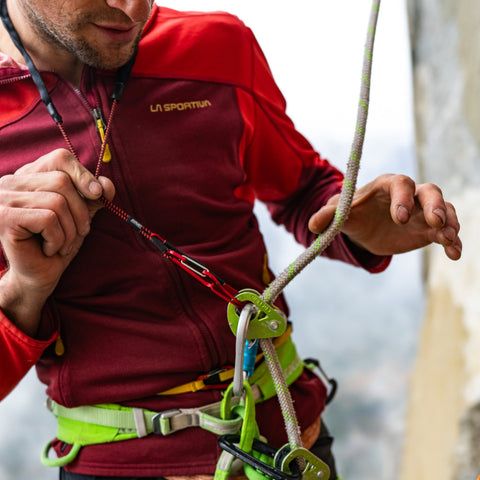
    1000006397.jpg

    Any potential problems I should be considering?

  • Not sure how active the rope solo scene is on fedi, but I figure I'd ask.

    There's been quite a bit of discussion over the years about various systems, but the modern consensus seems to be to use two progress capture devices on a single (or dual) fixed line, with one suspended higher than the other via use of a neck strap or chest harness.

    By far (at least in North America) the consensus seems to be to use the Petzl Microtraxion.

    The Edelrid Spoc seems to be a good alternative, is both lighter and cheaper, and is also mentioned occasionally in discussions about TRS.

    Brent Barghahn is seen in this photo in a double-Spoc setup:

    1000006397.jpg

    Any potential problems I should be considering?

    This post is deleted!
  • This post is deleted!

    This post is deleted!
  • Not sure how active the rope solo scene is on fedi, but I figure I'd ask.

    There's been quite a bit of discussion over the years about various systems, but the modern consensus seems to be to use two progress capture devices on a single (or dual) fixed line, with one suspended higher than the other via use of a neck strap or chest harness.

    By far (at least in North America) the consensus seems to be to use the Petzl Microtraxion.

    The Edelrid Spoc seems to be a good alternative, is both lighter and cheaper, and is also mentioned occasionally in discussions about TRS.

    Brent Barghahn is seen in this photo in a double-Spoc setup:

    1000006397.jpg

    Any potential problems I should be considering?

    @devnull
    In general, or specific to the devices?

    Note, I only read/watched information on TRS.

    Regarding devices in general, the most crucial things seem to be carabiner cross loading and devices getting unblocked.

    Regarding general aspects it makes sense to analyse all steps that could fail and check for mitigations.
    Like is doing in their Lead Rope Solo risk analysis video (https://www.youtube.com/watch?v=mTTDRX6RTWc).
    But I think more details could/should be included.

  • @devnull
    In general, or specific to the devices?

    Note, I only read/watched information on TRS.

    Regarding devices in general, the most crucial things seem to be carabiner cross loading and devices getting unblocked.

    Regarding general aspects it makes sense to analyse all steps that could fail and check for mitigations.
    Like is doing in their Lead Rope Solo risk analysis video (https://www.youtube.com/watch?v=mTTDRX6RTWc).
    But I think more details could/should be included.

    @devnull

    For cross loading, you might have seen the latest video by Yann Camus already
    https://www.youtube.com/watch?v=WXVF5zmPt_I

    And for other risks to consider, there is also the episodes on Top Rope Solo and Lead Rope Solo.

  • @devnull

    For cross loading, you might have seen the latest video by Yann Camus already
    https://www.youtube.com/watch?v=WXVF5zmPt_I

    And for other risks to consider, there is also the episodes on Top Rope Solo and Lead Rope Solo.

    @mkroehnert@social.tchncs.de I actually hadn't seen the latest video Yann put out, so that'll be on the list tonight!

    @HowNOT2's video is actually how I got interested in TRS in the first place! Really good and straightforward explanation of the mechanisms and risks involved.

  • This post is deleted!

    @pmonks@sfba.social @mkroehnert@social.tchncs.de That's a good list, although your two thoughts ended up being six 😆

    I've thought a bit about the idea of using two different devices. I was about to pull the trigger on a CAMP Lift, but I wasn't convinced of its safety given its tendency to no longer engage when grabbed or tilted (against a rock perhaps?) — additionally most rope soloists who climb with progress capture devices (again, talking North America) seem to go with the double-trax, which also doesn't satisfy the "two different devices" constraint.

    I will have an ascender (a tibloc + PAS) and a descender (Mammut Smart).

    As for rope protection, I was planning on re-fixing often so as to not worry (too much) about edge protection.

    Lastly, will be running all of this on my garage anchor board to get all these new skills (and devices!) tested for real before I get out on rock!

  • @mkroehnert@social.tchncs.de I actually hadn't seen the latest video Yann put out, so that'll be on the list tonight!

    @HowNOT2's video is actually how I got interested in TRS in the first place! Really good and straightforward explanation of the mechanisms and risks involved.

    @devnull
    I forgot, that has a collection of articles regarding Toprope solo.
    Including a non exhaustive list for risk analysis.

    You can find them at the end of the following page, where the first article is called 'To read for self-belaying'
    https://www.petzl.com/US/en/Sport/Indoor-and-Outdoor-Climbing

  • Not sure how active the rope solo scene is on fedi, but I figure I'd ask.

    There's been quite a bit of discussion over the years about various systems, but the modern consensus seems to be to use two progress capture devices on a single (or dual) fixed line, with one suspended higher than the other via use of a neck strap or chest harness.

    By far (at least in North America) the consensus seems to be to use the Petzl Microtraxion.

    The Edelrid Spoc seems to be a good alternative, is both lighter and cheaper, and is also mentioned occasionally in discussions about TRS.

    Brent Barghahn is seen in this photo in a double-Spoc setup:

    1000006397.jpg

    Any potential problems I should be considering?

    I use microtraction, an old ushba and a homemade neck/elastic loop. Works fine. Ushba is primary, micro traction is secondary. Very smooth. Pay close attention to how your system performs in overhanging terrrain.
  • Not sure how active the rope solo scene is on fedi, but I figure I'd ask.

    There's been quite a bit of discussion over the years about various systems, but the modern consensus seems to be to use two progress capture devices on a single (or dual) fixed line, with one suspended higher than the other via use of a neck strap or chest harness.

    By far (at least in North America) the consensus seems to be to use the Petzl Microtraxion.

    The Edelrid Spoc seems to be a good alternative, is both lighter and cheaper, and is also mentioned occasionally in discussions about TRS.

    Brent Barghahn is seen in this photo in a double-Spoc setup:

    1000006397.jpg

    Any potential problems I should be considering?

    This post did not contain any content.
Suggested topics


  • Guidebook XV—Rewind the Climb

    General News climbing
    1
    0 Votes
    1 Posts
    68 Views
    American Alpine ClubA
    The snowy fortress of Mt. Logan massif had opened its door after weeks of siege. It was June 23, 1925, when Allen Carpé and five others stood atop the highest peak in Canada for the first time, the sheer pinnacle of the summit plunging down sharply to the Seward Glacier below. To Carpé, in the thin air, it felt like every moment was twice lived. And in the media storm and flurry of drama that followed, he would be called upon to set the record straight—and relive those moments yet another time. At first glance, the 100-year-old story of the first ascent of Mt. Logan might have a familiar outline—a band of men push up and up to ascend to the great heights, facing great hardship along the way. In the classic telling, we follow the expedition leader Albert MacCarthy as he spends weeks caching supplies in the dead of winter, utilizing sleds pulled by snowshoe-clad horses, and higher up on the mountain, cunning dog teams that fight whenever left alone. In the classic telling, we follow MacCarthy, American Alpine Club representative Allen Carpé, American Norman Read, Colonel Foster, and the others on the expedition as they ferry their own gear back and forth between each subsequent camp, the measure of days the number of heavy loads these men have carried to the next advanced base camp, or their proximity to frostbite. With teeth on edge, we’d read of 11 journeys through a precarious icefall as they consolidated their camp above 10,000 feet, transporting nearly a ton of equipment and food. Once high on the massif, we’d delight in the cunning trick, attributed to MacCarthy, of planting 600 bare willow branches in the blowing snow every hundred feet, to prevent against getting lost in the whiteout. Such trail maintenance would ultimately save lives and precious time, but still couldn’t prevent one rope team from losing their way during a storm that chased them down from the summit. Those men spent 42 hours without shelter in the freezing, grainy snowbanks, only realizing their mistake when they found themselves walking in circles, back on the summit plateau, the slopes ominously appearing at unexpected angles. The theme of that story is loneliness, drudgery, and the sheer force of will needed against the worst conditions that such an icy world could offer. Reflecting on these themes, Carpé writes in his own telling of the ascent, published in 1933 in the American Alpine Journal: “I think it was during these days that the awful loneliness of these great ranges was first borne in upon me with something of the force of a personal experience. Until we turned the corner into the Ogilvie glacier, we could look back down the valley and sense the presence of the lower hills and of living things. Now as we worked in toward the savage cliffs of Logan we entered a new world of appalling grandeur, and our little band seemed insignificant and very much alone. We had no support behind us, no organization of supply, no linkage at all with the outer world. We were on our own.” That telling is perhaps best left to those who experienced it. But a 100-year distance can sharpen the focus of our lens on something else—the mundane letters and newspaper stories that came afterward, that can so easily be forgotten as part of the story, and that might tell us a little something different about the legacy our climbing ancestors have left us. There are, of course, the historical accounts—a hundred pages dedicated to the planning of the ascent, scientific studies accomplished during the expedition, and the story of the climb itself, all included in the Canadian Alpine Journal. Because the AAC was not yet publishing the American Alpine Journal (it would do so for the first time in 1929), the American account of the ascent was published in the Appalachian Mountain Club’s journal. The American public, too, was in awe, with repeated articles appearing in the New York Times, the Boston Transcript, and others. But a flurry of letters from September 1925, dashed off in angry haste with cross-outs and misspellings, reveal a gap in the telling. The writer, expedition member Norman Read, repeatedly argues to his friend and reader, Allen Carpé, that the representations of the expedition in the media are “positively disgusting in its sensationalism and its falsity.” He asks Carpé to write the story the right way—to tell it in a manner ‘worthy of the fraternity of mountaineering.’ The letters are a source of 100-year-old gossip—they tell of ... https://americanalpineclub.org/news/2025/8/14/guidebook-xvrewind-the-climb
  • 0 Votes
    1 Posts
    72 Views
    IFSCI
    https://www.youtube.com/watch?v=Gx82WaERGQc
  • 0 Votes
    1 Posts
    59 Views
    IFSCI
    https://www.youtube.com/watch?v=jdWbz6rD5rM
  • 0 Votes
    1 Posts
    156 Views
    GrippedG
    We talk with Herson to learn more about his ascent of the notoriously difficult Mason Earle line, which took him just two days of effort The post Connor Herson Completes Stranger Than Fiction 5.14 Trad in Record Time appeared first on Gripped Magazine. https://gripped.com/profiles/connor-herson-completes-stranger-than-fiction-5-14-trad-in-record-time/
  • Five Fun Moderate Bow Valley Ice Climbs

    General News climbing
    1
    1 Votes
    1 Posts
    94 Views
    GrippedG
    Some of the best intro-to-ice routes around Banff and Canmore for the 2024/2025 ice season The post Five Fun Moderate Bow Valley Ice Climbs appeared first on Gripped Magazine. https://gripped.com/news/five-fun-moderate-bow-valley-ice-climbs/
  • EDUCATE: The Forgotten Stonemaster

    General News climbing
    1
    0 Votes
    1 Posts
    97 Views
    American Alpine ClubA
    We are so excited to have longtime AAC member Rick Accomazzo on the podcast to chat about his new book “Tobin, the Stonemasters, and Me, 1970-1980.” This book is part memoir of Rick’s own early climbing career, part revealing biography of Tobin Sorenson, the forgotten Stonemaster who was an incredible all-arounder; and part a distillation of a decade of climbing culture. With these three threads, the book weaves together many untold climbing stories from an iconic, pivotal decade, from “before climbing lost its innocence,” as John Long says in his forward to the book. Listen to the episode to hear some key stories from the book and learn about the ten-year process of putting it together. We’d also like to congratulate Rick for his book being longlisted for the Banff Mountain Literature Award! Dive into the episode to get your dose of forgotten climbing history. You can grab your own copy at stonemasterbooks.com Buy the Book Banff Mountain Literature Awards https://americanalpineclub.org/news/2024/10/30/educate-the-forgotten-stonemaster
  • It’s Not Too Late to Climb Your Summer Project

    General News climbing
    1
    0 Votes
    1 Posts
    95 Views
    GrippedG
    Five tips to help complete that route you've been focusing on all year The post It’s Not Too Late to Climb Your Summer Project appeared first on Gripped Magazine. https://gripped.com/profiles/its-not-too-late-to-climb-your-summer-project/
  • Are backup knots a myth? #climbing #breaktest

    Videos climbing hownot2
    1
    0 Votes
    1 Posts
    109 Views
    HowNOT2H
    https://www.youtube.com/watch?v=4WXX-f8H9Sw