Skip to content

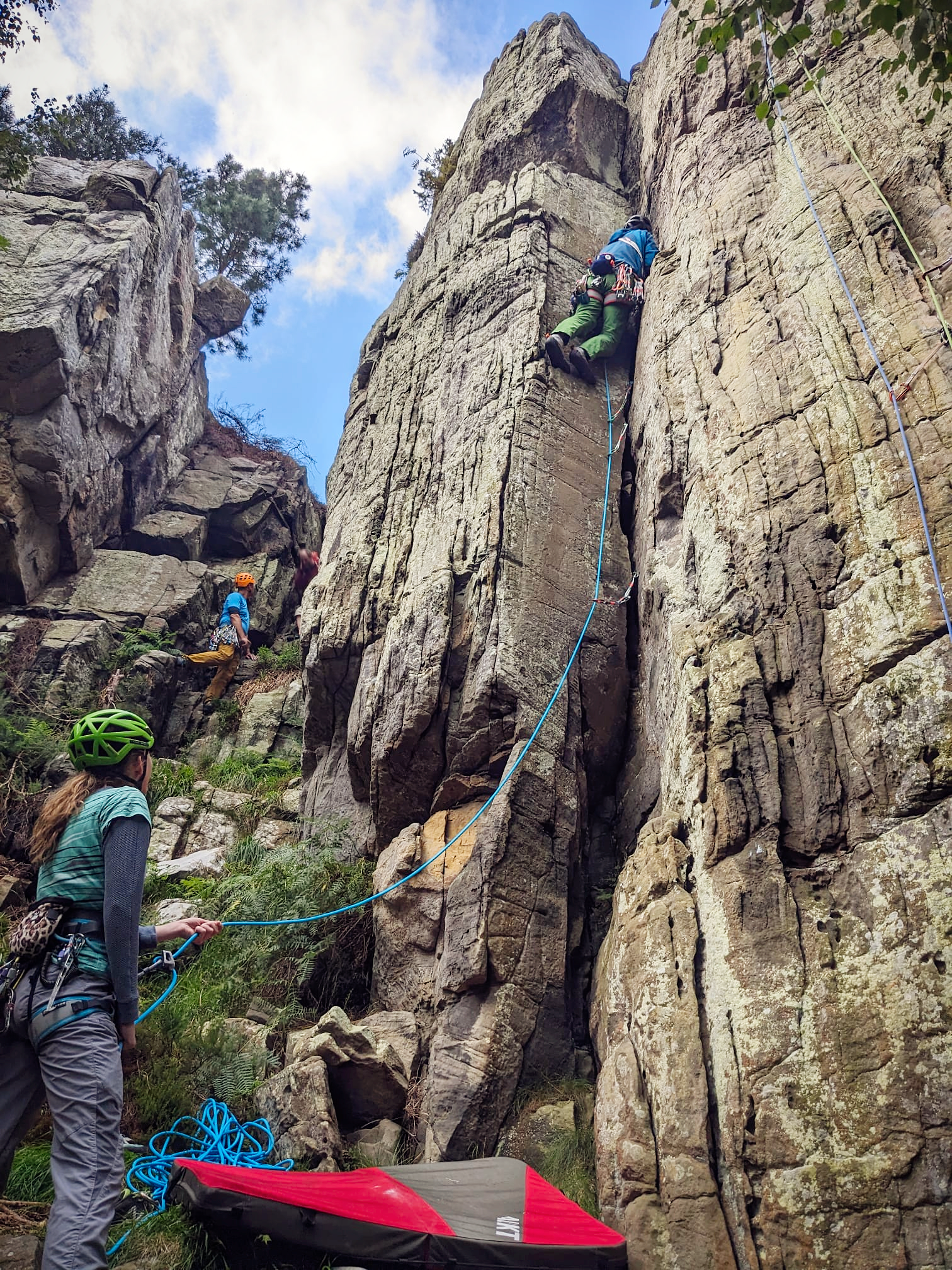
Deception Crack, a classic 2* Hard Severe at Kyloe Out.

Pics and trips
3 2 263

Suggested topics


  • Jules Marchaland flashes Power of Now Direct, 8C

    General News climbing
    1
    0 Votes
    1 Posts
    64 Views
    UK ClimbingU
    Jules Marchaland has made just the second ever flash of an 8C boulder, with his ascent of Power of Now Direct (f8C), in Magic Wood, Switzerland. https://www.ukclimbing.com/forums/t.php?n=784162
  • Guidebook XV—Member Spotlight: Rob Mahedy

    General News climbing
    1
    0 Votes
    1 Posts
    67 Views
    American Alpine ClubA
    Rob Mahedy, a 59-year-old cancer survivor from Crested Butte, Colorado, arrived in Alaska this spring with a purpose: to summit Mt. Hayes via the Washburn route. No stranger to high-altitude climbs—he’s soloed Mt. Earnslaw in New Zealand, Island Peak in Nepal, and Denali (Mt. McKinley)—Mahedy encountered a different kind of challenge this time. In Fairbanks, he heard reports of a milder winter and below-average snowpack, signs of a shifting climate he could not ignore. He adjusted course, choosing not to summit this year but to climb as far as the famed knife ridge, saving the final push for another expedition. As with his own survival, the lesson was clear: adaptation is not a sign of weakness—it’s wisdom. “I didn’t get to the top,” Mahedy said in an interview shortly after his eight days on Mt. Hayes, “but I do consider it a successful reconnaissance climb.” First climbed in 1941 with low-tech gear and legendary grit, the Washburn route to the Mt. Hayes summit is still considered one of Alaska’s great mountaineering achievements. Known formally as the North Ridge, the route’s reputation rests not only on its technical difficulty, but on the boldness of those who first dared to climb it. Towering 13,832 feet and rising more than 8,000 feet from the valley floor in just over two miles, Hayes is the tallest peak in the eastern Alaska Range—and one of the steepest in the country. So formidable is its Northeast Face that it wasn’t summited again until 1975, when climbers Charles R. Wilson and Steve Hackett led a four-person team across the ridge. In the American Alpine Journal that year, Wilson recalled sections so narrow and soft that “you could not put your feet side by side”—a place where progress toggled between precision and peril. Mahedy remembers a previous climb that took him to the top of Denali—the classic West Buttress, a route that was also pioneered by Bradford Washburn. Climbing with a small group at first, he broke off and made his way up during a 21-day adventure. “I stood atop the summit alone,” he recalled. “I had a clear summit day and could see down the Susitna River to Cook Inlet and west to the Bering Sea.” He descended for six days on skis. With Hayes, he was searching for a similar moment of stillness. To begin his Mt. Hayes climb along the Washburn route, Mahedy flew to Anchorage and then boarded the Alaska Railroad for the 12-hour trip to Fairbanks, where his local fact-finding began. A number of questions ran through Mahedy’s mind as he met up with experienced climbers in Fairbanks. “What am I up for, what am I getting myself into?” he wondered. “These people have local knowledge, so what went through my mind was, ‘What can I learn?’ ” Mahedy was confident about withstanding the bitter cold temperatures, which can drop below −4°F with windchill factors below −22°F. Even with his experience in Alaska and Nepal, he knew to be wary of the glacier travel and potential crevasse navigation ahead of him. Weighing heavier on Mahedy was how cancer would affect his strength and stamina. Mahedy, a muscular six-foot-four alpinist, left New Jersey for Crested Butte as a young man and quickly took to the mountains like a local. He hiked, skied, cycled, and climbed with the quiet intensity of someone who doesn’t just visit wild places but needs them and absorbs the solitude. A carpenter by trade, he’s helped restore many of the historical commercial buildings in Crested Butte’s bucolic downtown, shaping the town with the same hands that have gripped ice tools on Himalayan ridges. But his passion lies beyond the summits—deep in the hidden recesses of the backcountry. “I seek out remote mountain ranges that are not heavily visited,” he said. “I follow bighorn, mountain goats, elk, caribou—sometimes bear and wolverine—looking for freshwater springs, and often I’ll stumble on evidence of the people who were here before us.” For Mahedy, wilderness exploration isn’t just about elevation—it’s about connection, and the quiet stories the land can tell. Whether it’s a summit or a century ride, Mahedy tends to meet the landscape on its own terms—and rarely turns back. But his battle with aggressive bladder cancer and lung cancer since the middle of 2024 has taken its toll on his health and fitness. Last November, a tumor was removed from his abdomen along with his bladder. Doctors fashioned a replacement neobladder using material from his small intestine. Then his cancer—urothelial cell carcinoma—was found to have metastasized in his lungs, requiring weeks of chemotherapy. https://americanalpineclub.org/news/2025/8/14/guidebook-xvmember-spotlight-rob-mahedy
  • Guidebook XIV—Member Spotlight

    General News climbing
    1
    0 Votes
    1 Posts
    109 Views
    American Alpine ClubA
    Spacewalking outside the Hubble Space Telescope, John Grunsfeld wasn’t that much closer to the stars than when he was back on the surface of Earth, but it certainly felt that way. The sensation of spacewalking, of constantly being in freefall, but orbiting Earth fast enough that it felt like weightlessness, was more of a thrill than terrifying. Looking out to the vaster universe, seeing the moon in its proximity, the giant body of the sun, stole his breath away. Grunsfeld was experiencing a sense of exploration that very few humans get to. It was deeply moving, a sensation he also got in the high glaciated ranges when he’d look around and be surrounded by crevasses and granite walls of rock and ice. Throughout his life, he couldn’t help but seek out the most inhospitable places on the planet, and even beyond. You might think that there is nothing similar between climbing and spacewalking. But when you ask John Grunsfeld, former astronaut and NASA Chief Scientist—and an AAC member since 1996—about the similarities, the connections are potent. The focus required of spacewalking and climbing is very much the same, Grunsfeld says. Just like you can’t perform at your best on the moves of a climb high above the ground without intense focus on the next move and the currents of balance in your body, so, too, suited up in the 300-pound spacesuit, with 4.3 pounds per square inch of oxygen, and 11 layers of protective cloth insulation, you still have to be careful not to bump the space shuttle, station, or telescope as you go about the work of repairing and updating such technology—the job of the mission in the first place. Outside the astronaut’s suit is a vacuum, and Grunsfeld is not shy about the stakes. “Humans survive seconds when vacuum-exposed,” he says. With such high risks, it’s a shame that the AAC rescue benefit doesn’t work in space. Not only is spacewalking, like climbing, inherently dangerous, it also requires intense focus, and it can be a lot like redpointing. Grunsfeld reflects that “it’s very highly scripted. Every task that you’re going to do is laid out long before we go to space. We practice extensively.” In Grunsfeld’s three missions to the Hubble Space Telescope, his spacewalks were a race against the clock—the battery life and limited oxygen that the suit supplied versus the many highly technical tasks he had to perform to update the Hubble instruments and repair various electronic systems. It’s about flow, focus, and execution—skills and a sequence of moves that he had practiced again and again on Earth before coming to space. Similarly, tether management is critical. Body positioning, and not getting tangled in the tether, is important in order to not break something—say, kick a radiator and cause a leak that destroys Hubble and his fellow astronauts inside. But to Grunsfeld, the risk is worth it. The Hubble Space Telescope is “the world’s most significant scientific instrument and worth billions of dollars. Thousands of people are counting on that work.” Indeed, perhaps a little more is at stake than a send or a summit. Growing up in Chicago, Grunsfeld’s mind first alighted on the world of science and adventure through the National Geographic magazines he devoured, and a school project that had an outsized effect. Grunsfeld’s peers were assigned to write a brief biography of people like George Washington and Babe Ruth. Rather than these more familiar figures, Grunsfeld was assigned to research the life of Enrico Fermi—a nuclear physicist who was instrumental in the Manhattan Project, the creator of the world’s first artificial nuclear reactor, and a lifelong mountaineer. Suddenly, science and the alpine seemed deeply intertwined. Grunsfeld started climbing as a teenager, top-roping in Devil’s Lake, back when the cutting edge of gear innovation meant climbing by wrapping the rope around your waist and tying it with a bowline. Attending a NOLS trip to the Wind River Range and further expanding on his rope and survivor skills truly cemented his love of climbing in wild spaces. Throughout the years, climbing was a steady beat in his life, a resource for joy. He would climb in Lumpy Ridge, the Sierra, the White Mountains of New Hampshire, Tahquitz, Peru, Bolivia, and many other places with his wife, Carol, his daughter, and close friends like Tom Loeff, another AAC member. If climbing was a steady beat, his fascination with space and astrophysics would be a starburst. At first, his application to become a NASA astronaut was denied, but in 1992, Grunsfeld joined the NASA Astronaut Corps. It would shape the rest of his life’s work. Between 1... https://americanalpineclub.org/news/2025/5/19/guidebook-xivmember-spotlight
  • Kieran, what are you doing?

    Videos climbing
    1
    0 Votes
    1 Posts
    106 Views
    EpicTVE
    https://www.youtube.com/watch?v=ZSz6bBYjg-4
  • 0 Votes
    1 Posts
    119 Views
    GrippedG
    The V13 U.K. lowball features a desperate throw to the lip off some terrible feet The post “Worst Footholds I’ve Ever Used?” – Shauna Coxsey Tops Lupin V13 appeared first on Gripped Magazine. https://gripped.com/news/worst-footholds-ive-ever-used-shauna-coxsey-tops-lupin-v13/
  • 0 Votes
    1 Posts
    83 Views
    GrippedG
    It's shaping up to be one of the best ice climbing seasons in years so start getting prepared now The post 10 Tips for New Ice Climbers Who Want to be Successful appeared first on Gripped Magazine. https://gripped.com/profiles/10-tips-for-new-ice-climbers-who-want-to-be-successful/
  • 0 Votes
    1 Posts
    83 Views
    climbingC
    Kille says this whipper was actually in the "no fall zone" but his belayer reeled in a good armful of rope to keep him off the ground. https://www.climbing.com/videos/angus-kill-attempts-dangerous-trad-first-ascent/
  • A Week of Tragedies in the Mountains

    General News climbing
    1
    0 Votes
    1 Posts
    125 Views
    GrippedG
    https://gripped.com/news/a-week-of-tragedies-in-the-mountains/