Skip to content

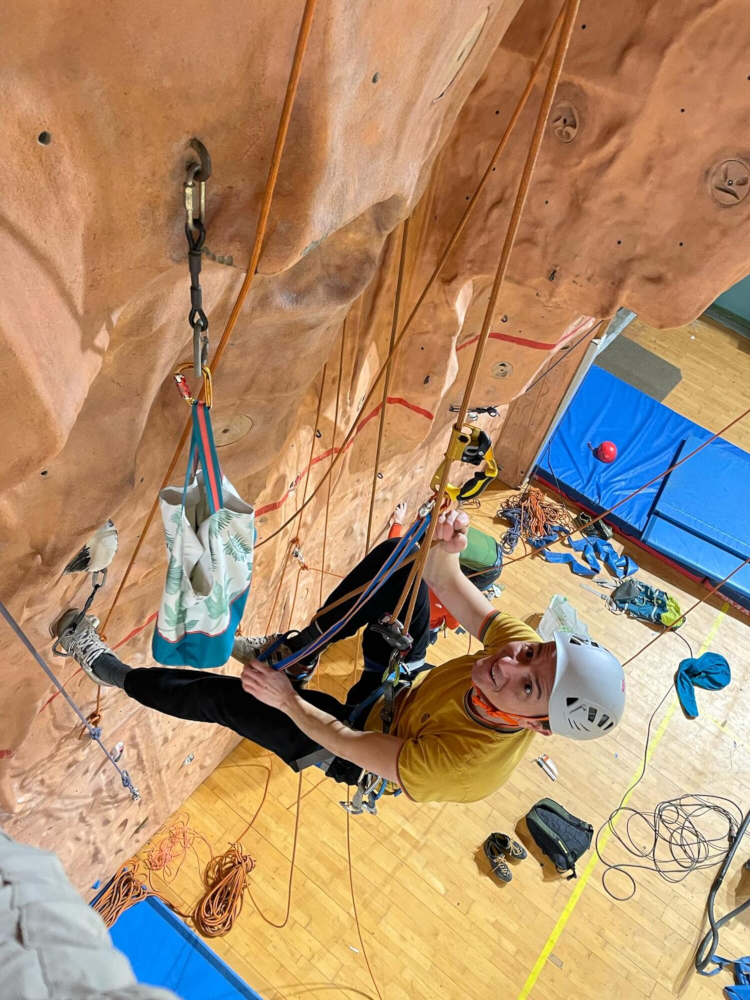
3 Tips To Make You A Better Belayer
Videos
1 1 117 1

Suggested topics


  • 0 Votes
    1 Posts
    22 Views
    Phil Strahl C.S.I.P
    ‪Lots of thing happening so I almost missed the North American release of Girl Climber which I graded. The low-light shots benefited from NeatVideo 6 and Topaz helped with reducing some highly compressed archival stuff.https://www.imdb.com/title/tt36437006/#colorist #colorgrading #climbing #documentary
  • The Prescription—Anchor Failure

    General News climbing
    1
    0 Votes
    1 Posts
    44 Views
    American Alpine ClubA
    This month we feature an accident that occurred in 2024 on Yosemite’s Manure Pile Buttress when a climber mistied a knot. You can reference this accident in this years Accidents in North American Climbing (page 46). The knot involved was bulky and involved multiple strands of webbing, brought together to tie a single anchor loop. The average climber only needs to know several simple knots but sometimes, even experts can get it wrong. This climber was lucky and escaped with minor injuries. On June 24, 2024 during the American Alpine Club’s United in Yosemite Climbing Festival, a climber led the first pitch of After Six (5.7). At the belay tree, they set up a lowering anchor using a knot on a quad-length sling with two locking carabiners. The climber weighted the rope and lowered. He cleaned the top piece of gear (a camming device). Below, a second cam proved too tight to remove so he unclipped it. The climber continued to lower. At the third piece from the top, the anchor knot failed. The climber fell 80 feet before the belayer caught his fall, when the climber was about five feet above the ground. The climber was lowered and SAR was called. His injuries included a sprained ankle, lacerations on the face, a broken nose, and rope burns on the hands and fingers.  A slipknot looks deceptively like other knots you'd use in a climbing anchor, but when you actually load it, it's not going to hold much at all. Pete Takeda, Editor of Accidents in North American Climbing, and IFMGA/AMGA Guide Jason Antin, are back to explain how a slipknot can have serious consequences when used in climbing anchors. Credits: Pete Takeda, Editor of Accidents in North American Climbing; IFMGA/AMGA Guide Jason Antin; Producers: Shane Johnson and Sierra McGivney; Videographer: Foster Denney; Editor: Sierra McGivney; Location: Accessibility Crag, Clear Creek, CO. The climber was fortunate that he had high protection that stopped him from hitting the ground when the anchor failed and lots of slack was introduced into the belay system. The anchor sling was found with an intact overhand knot. The belayer, who wishes to remain anonymous, wrote to ANAC: “We believe it was an attempted overhand knot but it was actually a slipknot.” The still-locked masterpoint carabiners were found clipped to the rope by the fallen climber.  *Editor’s Note: After analysis, it was determined that the climber had attempted to tie an overhand knot but failed to pull the two end strands completely through the knot. He then clipped the two locking carabiners through the unsecured loops. Since there were so many strands of webbing in the mix, it was hard to tell the difference between a fixed loop and a slip loop. When weighted, the slip loops had sufficient friction and compression to hold, if only momentarily, while the ends gradually crept toward release. (Sources: Anonymous and ANAC Canada Editor Robert Chisnall.) https://americanalpineclub.org/news/2025/11/12/the-prescription
  • The Height of Mountains

    General News climbing
    1
    0 Votes
    1 Posts
    130 Views
    American Alpine ClubA
    Originally published in Guidebook XIII Eric Gilbertson was on the summit of Rainier. Or was he? With the differential GPS set up in front of him, he hopped from foot to foot—it was cold up there, but he was also anxious to confirm his suspicions by applying a more rigorous measuring process to the changes he could see with the naked eye. Funded by the AAC Research Grant, he had used an Abney level to measure the relative heights of Columbia Crest, the traditional icecap summit of Rainier where he stood now, as compared to the actual highest point in the summit area—the southwest edge of the crater rim, which was a rock outcrop. Based on the Abney level, Columbia Crest was distinctly shorter than the southwest rim. With calculations spinning in his head, he noticed the unmistakably dirtier, more trampled quality of Columbia Crest, the way dirt and rocks seemed to muddle the pure snow dome, bringing a wilted quality to the landscape, especially compared to what he could remember seeing in old photographs of Rainier’s summit. He would have to wait to process the data from the differential GPS to be sure exactly by how much the summit had changed. Yet more than the relief of seeing his hypothesis likely confirmed, a bigger question loomed: Were mountains, which so many consider the stalwart indicator of the unmoving, the unchanging, the steady, actually shrinking? And what would it mean if they were? Eric Gilbertson is a man of many lists and projects. Each of his projects coalesces around peakbagging, and now surveying. The idea to research the current heights of the five remaining icecap peaks in the Lower 48, which includes Rainier, started when Mt. St. Helens eroded off the top 100 highest peaks of Washington list. Gilbertson had discovered that St. Helens had been steadily eroding by four inches each year since 1989, and because of that, St. Helens had technically fallen off the top 100 list around 2021. As an exacting, rigorous person who prizes accuracy above all in his life’s work, Gilbertson was intrigued—were there more discrepancy in the heights of the other top 100 Washington mountains? If his goal was to do all the hundred highest, and be the first to do them all in winter no less, he wanted to do it right. Before fact-checking the hundred highest list, before measuring the status of the five historical icecap peaks of the Lower 48, Eric and his brother Matthew had been pursuing what they called “The Country High Points Project.” Though the brothers are each respected alpinists in their own right, with several technical first ascents and inclusions in the American Alpine Journal to Eric’s name, they are peakbaggers at heart. Which is why they conceived of the project to get to the highest point of every country in the world, as defined by UN members and observer states, plus Antarctica. Thus, there are 196 highpoints on their list. So far, Eric has gotten to the highest point of 144 countries and Matthew has ticked 97. Eric says he sees the project as a framework for creating opportunities for really interesting adventures. “[It] kind of requires every kind of skill set you can imagine. It definitely requires high-altitude mountaineering, like K2 is on there and Everest, but it also requires jungle bushwhacking in the Caribbean or hiking through the desert in Chad. There is so much red tape you have to get through—like in West Africa there are so many police checkpoints so you have to navigate those—so many languages you have to speak, logistics to make it interesting, and the other interesting aspect is [sometimes we don’t know which] is the highest mountain, so in comes the survey equipment.” When, in 2018, the brothers determined the highest point in Saudi Arabia had actually been misunderstood all along, Eric became particularly interested in exactness and discovery, and how these elements added an interesting complexity to getting to the great heights of the world. A lot more was unknown than one might first imagine, given our information-overload culture. Not knowing if the mountain you were climbing was even the highest point in the country added a challenge that seemed to surpass even first ascenting. Yet Eric is not always flitting across to the farthest reaches of the world. As an associate teaching professor at Seattle University, he is rooted a good portion of the year, so he is constantly finding ways to feed his passion for discovery and peakbaggi... https://americanalpineclub.org/news/2025/2/10/guidebook-xiii-researchgrant
  • Fri Night Vid Between the Tides ft. Ross Fulkerson

    General News climbing
    1
    0 Votes
    1 Posts
    113 Views
    UK ClimbingU
    This week's Friday Night Video takes us to the Limestone cliffs of Mallorca, where Ross Fulkerson is exploring some of the island's newest lines, putting up first ascents, and trying out the moves on some of the hard classics. https://www.ukclimbing.com/forums/t.php?n=778403
  • Rams horn

    Videos climbing hownot2
    1
    0 Votes
    1 Posts
    101 Views
    HowNOT2H
    https://www.youtube.com/watch?v=B87sCqWAvWI
  • How to rappel on marginal anchors

    General News climbing alpinesavvy
    1
    0 Votes
    1 Posts
    97 Views
    AlpineSavvyA
    https://www.alpinesavvy.com/blog/how-to-rappel-on-marginal-anchors
  • 0 Votes
    1 Posts
    94 Views
    climbingC
    Bouldering is commonly referred to as a resistance-based sport, but there is a significant aerobic demand that can impact athletic performance and recovery time. https://www.climbing.com/skills/how-to-train-respiratory-muscles-for-climbing/
  • 0 Votes
    1 Posts
    104 Views
    UK ClimbingU
    https://www.ukclimbing.com/forums/t.php?n=773710