Skip to content

Keenan Griscom is Doing Everything Your Parents Tell You Not To Do

General News
1 1 88 1
  • Every year, ice climbers flock to the Ouray Ice Festival to test their skills on the human made ice flows in the park. A select few test their skills on the ice climbing competition wall. Routes are created that include ice, rock, and plywood in the Scottish Gullies section of the ice park. 
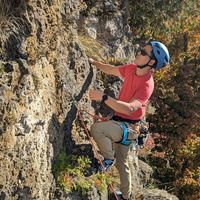
    The American Alpine Club sat down with USA ice climbing competitor Keenan Griscom. Griscom was rocking a North Face leopard-print 1996 retro Nuptse puffer and Y2K gray wrap-around sunglasses, as chill as the ice around us. We chatted about growing up competing in ice climbing competitions, his new link up Tommy's X (5.14b) in Clear Creek Canyon's Nomad’s Cave, and his experimental competition headspace. The experiment succeeded clearly, since Griscom took home the gold in the Ouray men's lead finals the next day.

    AAC: You were the youngest American to win the Ouray Elite Mixed Climbing Competition at age 16. When did you start climbing? How did you get into competitive ice climbing?

    Keenan Griscom: My dad actually started me ice climbing when I was four or five here in Ouray. So I've had tools for a long time. And then through Marcus Garcia, [I] found the competition scene and got hooked. I was doing rock comps, and the community in the ice climbing comps was just, so, so good and supportive and friendly, so, as someone who's already into competing, starting the ice comps is just like, oh, this is it. This is a cool spot to be in.

    AAC: What was it like competing at such a young age?

    KG: I don't know, I've been competing since I was nine. It was somewhat second nature. I've always wanted to give it [my] all in the comps. And Ouray was really special because when I started, there weren't any age categories. It was just the open format, and anyone could sign up. So if you were in, you're competing with everyone. My first two seasons, I didn't place particularly well. But it was so cool to be competing with people like Will Gadd and Ryan Vachon and all these epic mixed-climbers and alpinists who I looked up to.

    AAC: What drew you to continue doing competition ice climbing while you fell away from competition bouldering and rock climbing?

    KG: I stopped competing in rock comps mainly because the scene isn't as welcoming. There's a lot more toxic competitive nature there, and a lot of people get really worked up and will take other people down to get a better result. There's not really any of that in the ice climbing crew. Ice climbing comps are really fun. I'm going to stick with that. But I've been rock climbing outside nonstop.

    AAC: On that note, I noticed you put up an alternative finish to Tommy's Hard Route (5.13d)—Tommy's X (5.14b). What is the relationship between route development and ice climbing? How do those two things relate, if at all for you?

    KG: They don't relate a ton since I haven't really done much development for ice or mixed. I've gotten a lot of help from mentors like Marcus, who I met through ice climbing, to teach me development ethics. That route, specifically, it's in a cave near my house, and there's a lot of link ups. I didn't put in any new bolts [for Tommy's X] it was just a new line that hadn't been done yet.

    AAC: And what inspired you to do that?

    KG: Tommy's Hard Route (5.13d) is an old school natural line in a cave that's almost all manufactured. There is this really, really big dead point crux that I always thought was super, super interesting. Then it's over. You do this really gnarly dead point, and it's jugs to the chains. Which is nice, but more sustained climbing is more my style. There's this other route called Predator X (5.13a/b) that comes in from the left and finishes basically directly above that dead point. And one day, I was wondering if I could link those up, and then it'd be like a perfectly straight line of bolts through the wall. Yeah, it ended up being a really interesting crux sequence after the initial crux.

    AAC: That's awesome. You also boulder, can you tell me a little bit more about that?

    KG: Yeah, I grew up almost exclusively sport climbing, and then started to do ...


  • Sport ChannelS Sport Channel shared this topic on

Suggested topics


  • 0 Votes
    1 Posts
    47 Views
    American Alpine ClubA
    The vast Nyanchen Tanglha (a.k.a. Nyainqentanglha) ranges in Tibet span more than 750 kilometers in an arc north of Lhasa—it’s one of the world’s great collections of unclimbed or seldom-climbed high peaks. In the first decade of the 2000s, the Japanese geographer and photographer Tamotsu Nakamura, an AAC honorary member, published a series of articles describing these mountains, including a three-part opus in AAJ 2003 on mountains “East of the Himalaya” (also the title of Nakamura’s landmark 2016 book), with enticing photos from the Nyanchen Tanglha East range. A bit of a gold rush followed, with various Western climbers snagging the first ascents of attractive summits in Nakamura’s photos. However, there are major logistical difficulties to climbing in this area, including road access and permits. The last AAJ articles about climbs in the Nyanchen Tanglha by Western climbers were published in 2017. Into the breach has stepped a cohort of Chinese alpinists who have rapidly gained experience and skill in their home mountains in recent years. Now ready to tackle more difficult and remote objectives, they have made many impressive ascents, aided in part by rapid development of road and rail networks in Tibet. Three climbs from late 2024 are highlighted below. These reports could not be completed in time for the 2025 AAJ, but these ascents and many more in Tibet will be described in detail in next year’s book. Many thanks to Xia Zhongming, who facilitates and writes AAJ reports from China— including these three—and has contributed greatly to the world’s knowledge of modern Chinese alpinism. In 2005, British climbers Mick Fowler and Chris Watts made the first ascent of Kajaqiao in the Nyanchen Tanghlha East mountains. Two years later, Fowler returned with fellow Brit Paul Ramsden to climb Manamcho, a spectacular, Matterhorn-like peak nearby, by the northwest ridge. In September 2024, Chinese alpinists Liu Junfu and Wang Shuai climbed Manamcho’s second route, up the southwest side of the 6,264-meter mountain, in one long day from high camp. To overcome a crux rock slab near the top, Liu tied a rope to one of his ice tools and threw it up the rock. After more than ten tries, the tool stuck and Liu was able to batman up the rope and surmount the slab, opening the way to the summit. See the full report. In the southwest section Nyanchen Tanglha East lies Nenang (6,870m), the highest of this range’s unclimbed peaks. Around 10 kilometers from Nenang to the west and east stand two spectacular mountains: Chuchepo (6,613m), west of Nenang, and Jiongmudazhi (6,590m) to the east. Both peaks were noted in AAJ 2007, but no known attempts were made on either peak until August 2024, when Tong Haijun and Wang Yongpeng from China climbed Chuchepo by a direttissima on the northeast face. On August 16, the two began their approach from the Niwu Valley to the north, establishing advanced base at 5,300 meters after an 11-hour day. From there they scoped a feasible line up the northeast face. The next day, the pair spent seven hours crossing the snow-covered, crevassed glacier before camping at 5,900 meters. On the 18th, the two left camp at 3 a.m., and after a difficult pitch to cross the bergschrund, they continued up easier terrain to reach 6,230 meters before sunrise. The major technical difficulties now followed. Wang led a pitch where the ice was too thin to place screws and the rock too compact for cams. Tong then climbed a very run-out pitch on snow-covered compact rock. After this, the snow became deeper and the difficulties eased. Wang made a final belay in deep snow a couple of meters below the summit ridge, and Tong then tunneled through the cornice and continued up left to the highest point. The 700-meter route was graded D+ M4 AI3 75°. See the full report. Less than a month after climbing Chuchepo, Tong Haijun and Wang Yongpeng returned to the area in September 2024 to attempt the first ascent of Jiongmudazhi (6,590m). Again, Tong and Wang approached from the north, via the Biyong Glacier, where they spent a very difficult day bypassing an 800... https://americanalpineclub.org/news/2025/10/9/the-line-stunning-peaks-in-china
  • Man Who Died in a Glacier in 1997 is Found

    General News climbing
    1
    0 Votes
    1 Posts
    62 Views
    GrippedG
    The discovery has brought closure to his family, who'd been searching for nearly 30 years The post Man Who Died in a Glacier in 1997 is Found appeared first on Gripped Magazine. https://gripped.com/news/man-who-died-in-a-glacier-in-1997-is-found/
  • 1 Votes
    1 Posts
    123 Views
    GrippedG
    She would go on to become the first woman to climb the Seven Summits The post 50 Years Ago, Junko Tabei Became First Woman to Climb Everest appeared first on Gripped Magazine. https://gripped.com/profiles/50-years-ago-junko-tabei-became-first-woman-to-climb-everest/
  • 0 Votes
    2 Posts
    270 Views
    Andrew HelwerA
    Regrettably accepting that I will not be sincerely good at rock climbing (climb 5.12+) unless I legitimately lose 30 lbs. I'm about 205 lbs now on a 6'2 frame, which puts me at a BMI of 26.3. I've become pretty large muscle-wise after switching from climbing to BJJ, since the sport facilitates & also advantages that. Even before switching from climbing to BJJ I noticed I had to use *way* more force to hang onto certain holds than other people I climbed with, just because I weighed more. Losing 30 lbs would get me to 175 lbs, 22.5 BMI, which (limited) data suggests is around where you want to be to be decent at climbing (ideally even lower).There's also a safety aspect to this. Past 200 lbs, ropes will shred more easily when running over sharp edges after taking a fall. More force just means less safety.At age 34 though losing 30 lbs is like a fantasy. I have no idea how I would even do that. Climb Mt Si 3x/week with a 40 lb pack maybe? Spouse points out that I eat quite a lot of bread per week, so maybe will start with substituting that for something else.#climbing
  • 1 Votes
    1 Posts
    128 Views
    Lumi AkimovaL
    This weekend tried ice climbing for the first time. With small drytooling experience, soft-ish ice and slightly positive slope it was surprisingly easy. Once did 5 climbs with no breaks, and only stopped because of queueAlso tried different ice tools: my new Trango Raptor, Petzl Sum'tec and two variations of non striking tools. Non striking are physically easy to to use when ice is not flat, but are harder to trust. Raptors are holding best, but the striking motion is harder to master because of the blade angle. Sum'tecs are just the easiest for beginnersAnd this was an actual frozen waterfall!(more like a frozen shell around still flowing waterfall, and the ice in the middle was quite thin and not attached to the rock)#climbing #mountains #ice
  • Speed qualifications | Seoul 2024

    Videos climbing ifsc
    1
    0 Votes
    1 Posts
    106 Views
    IFSCI
    https://www.youtube.com/watch?v=YJ4xIjgNC1s
  • Speed finals | Villars 2024

    Videos climbing ifsc
    1
    0 Votes
    1 Posts
    93 Views
    IFSCI
    https://www.youtube.com/watch?v=XCxZ2i5rxhQ
  • Jonathan Siegrist on Hard Sport Climbs

    General News climbing
    1
    0 Votes
    1 Posts
    96 Views
    GrippedG
    https://gripped.com/news/jonathan-siegrist-on-hard-sport-climbs/