Double Spoc; top rope solo
-
Not sure how active the rope solo scene is on fedi, but I figure I'd ask.
There's been quite a bit of discussion over the years about various systems, but the modern consensus seems to be to use two progress capture devices on a single (or dual) fixed line, with one suspended higher than the other via use of a neck strap or chest harness.
By far (at least in North America) the consensus seems to be to use the Petzl Microtraxion.
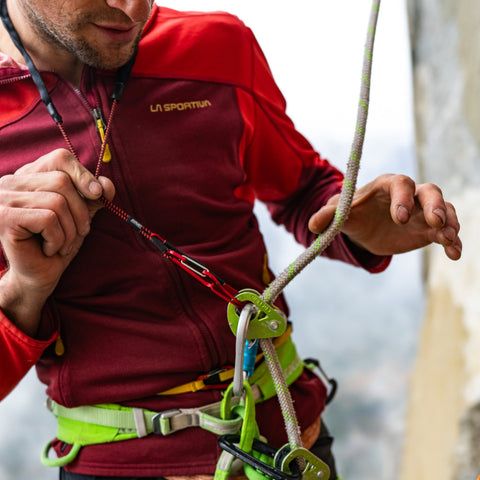
The Edelrid Spoc seems to be a good alternative, is both lighter and cheaper, and is also mentioned occasionally in discussions about TRS.
Brent Barghahn is seen in this photo in a double-Spoc setup:
Any potential problems I should be considering?
-
Not sure how active the rope solo scene is on fedi, but I figure I'd ask.
There's been quite a bit of discussion over the years about various systems, but the modern consensus seems to be to use two progress capture devices on a single (or dual) fixed line, with one suspended higher than the other via use of a neck strap or chest harness.
By far (at least in North America) the consensus seems to be to use the Petzl Microtraxion.
The Edelrid Spoc seems to be a good alternative, is both lighter and cheaper, and is also mentioned occasionally in discussions about TRS.
Brent Barghahn is seen in this photo in a double-Spoc setup:
Any potential problems I should be considering?
This post is deleted! -
This post is deleted!
This post is deleted! -
Not sure how active the rope solo scene is on fedi, but I figure I'd ask.
There's been quite a bit of discussion over the years about various systems, but the modern consensus seems to be to use two progress capture devices on a single (or dual) fixed line, with one suspended higher than the other via use of a neck strap or chest harness.
By far (at least in North America) the consensus seems to be to use the Petzl Microtraxion.
The Edelrid Spoc seems to be a good alternative, is both lighter and cheaper, and is also mentioned occasionally in discussions about TRS.
Brent Barghahn is seen in this photo in a double-Spoc setup:
Any potential problems I should be considering?
@devnull
In general, or specific to the devices?Note, I only read/watched information on TRS.
Regarding devices in general, the most crucial things seem to be carabiner cross loading and devices getting unblocked.
Regarding general aspects it makes sense to analyse all steps that could fail and check for mitigations.
Like #Edelrid is doing in their Lead Rope Solo risk analysis video (https://www.youtube.com/watch?v=mTTDRX6RTWc).
But I think more details could/should be included. -
@devnull
In general, or specific to the devices?Note, I only read/watched information on TRS.
Regarding devices in general, the most crucial things seem to be carabiner cross loading and devices getting unblocked.
Regarding general aspects it makes sense to analyse all steps that could fail and check for mitigations.
Like #Edelrid is doing in their Lead Rope Solo risk analysis video (https://www.youtube.com/watch?v=mTTDRX6RTWc).
But I think more details could/should be included.For cross loading, you might have seen the latest video by Yann Camus already
https://www.youtube.com/watch?v=WXVF5zmPt_IAnd for other risks to consider, there is also the #HowNot2 episodes on Top Rope Solo and Lead Rope Solo.
-
For cross loading, you might have seen the latest video by Yann Camus already
https://www.youtube.com/watch?v=WXVF5zmPt_IAnd for other risks to consider, there is also the #HowNot2 episodes on Top Rope Solo and Lead Rope Solo.
@mkroehnert@social.tchncs.de I actually hadn't seen the latest video Yann put out, so that'll be on the list tonight!
@HowNOT2's video is actually how I got interested in TRS in the first place! Really good and straightforward explanation of the mechanisms and risks involved.
-
This post is deleted!
@pmonks@sfba.social @mkroehnert@social.tchncs.de That's a good list, although your two thoughts ended up being six

I've thought a bit about the idea of using two different devices. I was about to pull the trigger on a CAMP Lift, but I wasn't convinced of its safety given its tendency to no longer engage when grabbed or tilted (against a rock perhaps?) — additionally most rope soloists who climb with progress capture devices (again, talking North America) seem to go with the double-trax, which also doesn't satisfy the "two different devices" constraint.
I will have an ascender (a tibloc + PAS) and a descender (Mammut Smart).
As for rope protection, I was planning on re-fixing often so as to not worry (too much) about edge protection.
Lastly, will be running all of this on my garage anchor board to get all these new skills (and devices!) tested for real before I get out on rock!
-
@mkroehnert@social.tchncs.de I actually hadn't seen the latest video Yann put out, so that'll be on the list tonight!
@HowNOT2's video is actually how I got interested in TRS in the first place! Really good and straightforward explanation of the mechanisms and risks involved.
@devnull
I forgot, that #Petzl has a collection of articles regarding Toprope solo.
Including a non exhaustive list for risk analysis.You can find them at the end of the following page, where the first article is called 'To read for self-belaying'
https://www.petzl.com/US/en/Sport/Indoor-and-Outdoor-Climbing -
Not sure how active the rope solo scene is on fedi, but I figure I'd ask.
There's been quite a bit of discussion over the years about various systems, but the modern consensus seems to be to use two progress capture devices on a single (or dual) fixed line, with one suspended higher than the other via use of a neck strap or chest harness.
By far (at least in North America) the consensus seems to be to use the Petzl Microtraxion.
The Edelrid Spoc seems to be a good alternative, is both lighter and cheaper, and is also mentioned occasionally in discussions about TRS.
Brent Barghahn is seen in this photo in a double-Spoc setup:
Any potential problems I should be considering?
I use microtraction, an old ushba and a homemade neck/elastic loop. Works fine. Ushba is primary, micro traction is secondary. Very smooth. Pay close attention to how your system performs in overhanging terrrain. -
Not sure how active the rope solo scene is on fedi, but I figure I'd ask.
There's been quite a bit of discussion over the years about various systems, but the modern consensus seems to be to use two progress capture devices on a single (or dual) fixed line, with one suspended higher than the other via use of a neck strap or chest harness.
By far (at least in North America) the consensus seems to be to use the Petzl Microtraxion.
The Edelrid Spoc seems to be a good alternative, is both lighter and cheaper, and is also mentioned occasionally in discussions about TRS.
Brent Barghahn is seen in this photo in a double-Spoc setup:
Any potential problems I should be considering?
This post did not contain any content.



Hello! It looks like you're interested in this conversation, but you don't have an account yet.
Getting fed up of having to scroll through the same posts each visit? When you register for an account, you'll always come back to exactly where you were before, and choose to be notified of new replies (either via email, or push notification). You'll also be able to save bookmarks and upvote posts to show your appreciation to other community members.
With your input, this post could be even better 💗
Register Login