Skip to content

Two 8c multi-pitch repeats for Jacopo Larcher and Babsi Zangerl

General News
1 1 125 1

Suggested topics


  • Interesting article about climbing and OCD

    General Climbing climbing ocd fear
    1
    0 Votes
    1 Posts
    37 Views
    stibS
    Interesting article about climbing and OCD.Fear is certainly a big part of the sport, particularly lead climbing, and learning to deal constructively with fear is one of the most rewarding parts. https://www.climbing.com/culture-climbing/what-it-feels-like-to-climb-with-obsessive-compulsive-disorder/#Climbing #OCD #Fear
  • 0 Votes
    1 Posts
    56 Views
    GrippedG
    The 400-metre Les Chercheurs d’Or was climbed in "arctic conditions" using lots of aid and a portaledge The post New 14-Pitch Big Wall Style Climb in Quebec Took 7 Days appeared first on Gripped Magazine. https://gripped.com/news/new-14-pitch-big-wall-style-climb-in-quebec-took-7-days/
  • Famous Patagonia Route Gets First Winter Ascent

    General News climbing
    1
    0 Votes
    1 Posts
    93 Views
    GrippedG
    Matteo Della Bordella and Marco Majori have made history with the first winter ascent of Casarotto route on Fitz Roy The post Famous Patagonia Route Gets First Winter Ascent appeared first on Gripped Magazine. https://gripped.com/news/famous-patagonia-route-gets-first-winter-ascent/
  • Raharjati Nursamsa 🇮🇩 | Athlete of the Week

    Videos climbing ifsc
    1
    0 Votes
    1 Posts
    73 Views
    IFSCI
    https://www.youtube.com/watch?v=SSEhL4PYzKo
  • The Prescription—Top-Rope Solo

    General News climbing
    1
    0 Votes
    1 Posts
    181 Views
    American Alpine ClubA
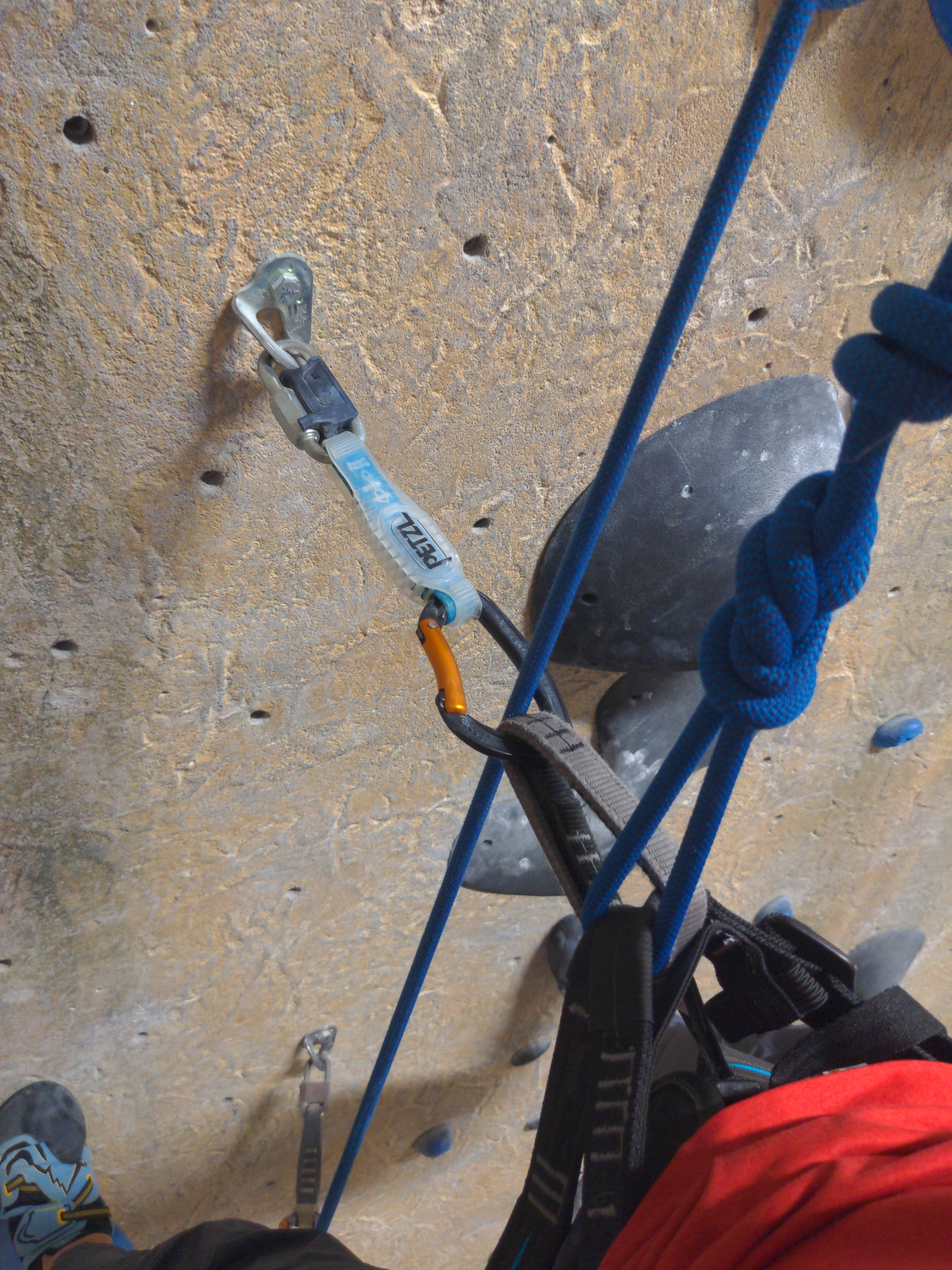
    In this month’s Prescription, an expert climber made two crucial errors in her rope ascension/top-rope solo system. She fortunately escaped with relatively minor injuries. This accident was featured in the 2024 Accidents in North American Climbing. On October 8, 2023 Whitney Clark was ascending a fixed rope at the start of Valkyrie (17 pitches, 5.11+) when her single ascension device was jammed by a sling. She fell 30 feet to the ground. Clark wrote to ANAC: “We woke at around 6 a.m. and made our way to the fixed line from the day before. The days were short and we had many pitches to do. My partner, Luka Krajnc, went first, using a Grigri to jug and then transitioning to climbing. About 40 feet up, he clove-hitched the rope to a bolt. I then started jugging with a single Micro Traxion. Thirty feet up, I leaned back on the rope. My body weight wasn’t supported because the sling around my neck [part of the top-rope solo setup] got sucked into the device and caught in the teeth of the Traxion. The rope was sliding against the sling. I hadn’t tied a backup knot.” Clark attempted to wrap the rope around her leg. But her rope was new, thin, and slippery. She wrote, “I grabbed the rope and slowly started sliding down. Eventually the rope burn was too painful and I let go. I hit the ground, landed on my feet, and fell backward. I struck my lower back and then my head. I was wearing a helmet. Because the ground was angled, some of the force was dissipated, though I landed six inches from a large rock spike. “I never lost consciousness but was in a bit of shock. Luka rappelled down and did a spinal exam. He got me comfortable, and I sat there for a while. I had pain in my back and my left ankle. I used my inReach to call for a rescue while Luka retrieved our stuff. I started crawling and butt-scooting to where a heli could reach me. I would have loved to have self-rescued, but it’s a 16-mile hike out. It took about 2.5 hours of crawling to make it to a flat place. Four hours later, a helicopter airlifted me to the Visalia Level III trauma center.”  Whitney Clark’s progress-capture device failed when the as-yet-unused retention sling got stuck in the device as she was ascending. It is common practice to use a sling and an elastic connection to hold the progress-capture device upright as one climbs along a fixed rope. Photo: Luka Krajnc Top-rope soloing is becoming increasingly popular. In this video, Pete Takeda, Editor of Accidents in North American Climbing, and IFMGA/AMGA guide Jason Antin are back to provide an accident analysis and give you some quick tips on how to mitigate risk when top-rope soloing. Top-rope soloing is an integral part of modern climbing. Currently, only one device (the El Mudo) is designed and commercially available for top-rope (and lead) soloing. There are many ways to configure these systems and we’ve demonstrated one possible solution here. Solo top-roping allows a climber to self-belay when no partner is available, for a team to work on individual sections of a route without the need for a belayer, or for two climbers to move simultaneously, as in this situation. The errors Clark made were using only one device to safeguard her progress and not tying a backup knot. “I was jugging by pulling on the rope, syncing up the slack, and sitting back,” Clark said. “The route was meandering and the fixed line didn’t allow me to readily climb, so I decided to jug straight up the initial blank slab. The sling around my neck was going to hold the Traxion upright [allowing the rope to feed freely] once I started climbing. I haven’t done any top-rope soloing since the accident. I probably will at some point, but I will definitely use two devices. This was the first time I only used a single progress-capture device.”  (Source: Whitney Clark.) Each membership is critical to the AAC’s work: advocating for climbing access and natural landscapes, offering essential knowledge to the climbing community through our accident analysis and documentation of cutting edge climbing, and supporting our members with our rescue benefit, discounts, grants and more. Plus, get the new 2025 member tee! https://americanalpineclub.org/news/2025/2/11/the-prescription
  • A Climber We Lost: Stewart M. Green

    General News climbing
    1
    0 Votes
    1 Posts
    134 Views
    climbingC
    Each January we post a farewell tribute to those members of our community lost in the year just past. Some of the people you may have heard of, some not. All are part of our community. https://www.climbing.com/people/a-climber-we-lost-stewart-green/
  • Guidebook XII—Rewind the Climb

    General News climbing
    1
    0 Votes
    1 Posts
    201 Views
    American Alpine ClubA
    By Hannah Provost If you had to tell the story of the evolution of climbing within the history of one route, your most compelling choices might be The Nose of El Capitan or The Naked Edge in Eldorado Canyon. In this way, The Naked Edge is a time capsule containing within its memory: the much dreamed-of first ascent finally climbed by Layton Kor, Bob Culp, and Rick Horn; a period defining free ascent by Jim Erickson and Duncan Furgeson in the early 1970s; and one of the few battle- grounds for speed records in the United States. In 1962, Kor and Bob Culp were diverted attempting to aid the steep final edge, and today, climbers have speed climbed the route, bridge to bridge, in a little over 22 minutes. What is it about this climb that has allowed it to be the sketchbook for climbing legends to draw out the evolution of our sport? Anecdotes and artifacts from the American Alpine Club Library and archives provided the answer. Perhaps it was all aesthetics—the compelling imagery of a climb that could divide dark- ness and light. Or maybe it was the fact that The Edge tends to rebuff many of its suitors. But whether The Naked Edge was dishing out a good humbling, or whether, as Jim Erickson famously argued, his free ascent style “humbled the climb” instead, The Naked Edge might live so prominently in our collective climbing memory because it encapsulates one of the great questions of each climbing endeavor. Who holds the power here? The climb or the climber? At first, the route held all the cards. Layton Kor, known for his hulking height and wild, almost demonic, drive, could usually weaponize his determination and fearlessness to get through any hard climbing he might envision for himself. Yet when Layton Kor and Bob Culp attempted to aid the route in 1962, having each been turned away in 1961 on separate occasions, they still had to deviate from the original vision and finished the climb via a dihedral slightly to the left of the stunning final overhang. It wasn’t until Kor came back with Rick Horn in 1964 that The Edge, as we climb it today, was first done in its entirety. Jim Erickson, a young gun with a knowing grin, hadn’t always been a hotshot. However, by the early 1970s, he had gotten into the habit of proving a point—freeing the old obscure aid lines in Eldo put up by Robbins, Kor, Dalke, and Ament the decade before. After several failed attempts to free The Naked Edge, repeatedly retreating from the first pitch finger crack due to a strict avoidance of hangdog- ging and rehearsing, freeing The Naked Edge was his foremost ambition. By 1971, The Naked Edge had been ascended 30 or so times using direct aid. Erickson was envisioning a new phase of the route’s life. Yet his first moderately successful attempt, with prolific free climber Steve Wunsch, was yet another humbling. As he wrote for Climb!: The History of Rock Climbing in Colorado, the fourth pitch was daunting to the point of existential: “Steve dubs it impossible. I give it a disheartened try, but it is late so down we come, pondering the ultimate metaphysical questions: ‘Is there life after birth? Sex after death?’” When Erickson and Duncan Ferguson returned a week later, things went a little more smoothly. Though The Naked Edge was the last major climb that the two would ascend using pitons, it wasn’t the use of pitons that haunted Erickson and sent him off on his staunch commitment to only onsight free -climbing. Rather, when Erickson reflects on the effort and technique of pitoncraft, and the incredible added effort of free climbing on pitons, he seems almost to be creating something, tinkering. Describing nailing the crux of the first thin pitch in an interview for the Legacy Series, a project of the AAC to preserve the history of climbing, Erickson painted a picture of immense toil: “You’re in this strenuous fingertip layback, with shoes that didn’t smear very well...You had to first of all figure out which piton you were going to place, you had to set it in the crack, you were doing all of this with one hand while you were hanging on. Then you had to tap the piton once to make sure you didn’t lose it... because if you missed it and dropped it you’re back to square one, so you had to tap the pin, finally hit it in, test it to see if it was good, then you’d clip a single free carabiner, and a second free carabiner into it, and then you would clip your rope in, all while you were hanging on with one hand in a bad finger lock.” In the 1960s and 1970s, once a route was freed, it was not ... https://americanalpineclub.org/news/guidebook-xiirewind-the-climb
  • Climbing Norway’s Hardest Mixed Route

    General News climbing
    1
    0 Votes
    1 Posts
    126 Views
    GrippedG
    A new video just dropped featuring some hard winter climbing and a first ascent The post Climbing Norway’s Hardest Mixed Route appeared first on Gripped Magazine. https://gripped.com/news/climbing-norways-hardest-mixed-route/