Skip to content

U17 Lead finals | Helsinki 2025
Videos
1 1 76 1

Suggested topics


  • 0 Votes
    1 Posts
    92 Views
    American Alpine ClubA
    I move, therefore I am. I reminded myself of this throughout the journey to and from Arviqtujuq Kangiqtua, formerly known as Eglinton Fjord. Throughout our five-week, multi-sport, primarily human-powered expedition to Baffin Island, in the Canadian Arctic, Kelly Fields, Shira Biner, Natalie Afonina, and I continued to move. We skied over 100 miles across the sea ice in order to get there, and we slogged for another 100 miles over moraine fields, loose talus, sinking meadows, a frozen lake, and a partially frozen river to get out. Movement was our rule, our rhythm. And as a team of three women and a non-binary person, we were motivated to define this movement on our own terms. Kelly, Shira, Natalie, and I met for the first time in person at the Ottawa Airport en route to the Arctic. Only a few of us had tied in together before this trip. Prior to our real-life introduction, we spent months exchanging messages, photos, screenshots, videos, and group calls on WhatsApp. Now, past the logistical chaos of prep for this expedition, we still had a lot of learning to do about each other. I’m lucky in that I know an abundance of female, non-binary, and queer people who are incredible climbing partners. I prefer to rope up with them because of my ongoing struggles with self-confidence and self-trust that I learned in the shadow of my male climbing partners. Here was an opportunity to move toward my goals and the style of climbing that most inspires me, alongside a group of people who uplift one another. When we received our first grant—the McNeill-Nott Award from the American Alpine Club—I started to feel that other people believed in us, which gave me more belief in myself. Representation is important, and the organizations that supported us believed that too. It was coming together all too perfectly. I stared at the vast ice and seascape before me: Circles of white interrupted the piercing blue water that settled up to a foot deep in some places. We were leaving the bay in the small Inuit community of Clyde River. The gray sky let go of gentle snowflakes that melted on my sunglasses, making my surroundings appear as if I were looking out a window on a rainy day. “So...how thick is this ice?” I asked, my voice wavering. The last time I had put skis on was a number of years ago. On snow, on solid ground. However, I was soon submerged within and captivated by the ice’s symphony as we glided, heaved, soared over, walked, and trudged—depending on the conditions of the sea ice—over a hundred miles on a seascape that was constantly changing. Moving through that environment was dictated by the wind, temperature, snow, and our bodies’ needs. One moment, we would be trapped in a cloud, the snow absorbing the sound around us and sticking to our ski skins so thick that we had to take them off. Moments later, after turning a corner, the winds had blown the clouds and snow off the surface, and we found ourselves flying over the best ice conditions we had yet experienced. That landscape spoke to me, telling me that it, too, exists in states of movement and change. I often look to the natural world to find my own sense of belonging. Being a non-binary person often means that I don’t always find a type of belonging that is representative. I struggle in groups of men. In groups of women, I push back on the definitions and create an exclusionary space for myself. Asking for a non-binary category creates the exact thing I don’t want to exist within: a category. One day, I hope I can exist in a way that is outside the confines of man or woman—that I can exist as myself without needing to choose between explaining and educating, or quietly disrespecting myself. The thing about gender, being non-binary specifically, is that it’s simultaneously the most painful and most beautiful experience one can have. There is a deep gratitude in being the truest form of yourself; there is a wholeness in accepting one’s authenticity. It can also often be painful to a core level. My relationship with gender is like the Arctic wind: always present, sometimes gentle and caressing, other times a chaos that threatens to knock me down. I felt the spirits skiing into Arviqtujuq Kangiqtua. Finally, among those great walls, exhausted, hungry, sore, and cold, we debated where to set up our base camp and had a hard time getting anywhere productive with it. I remember feeling confused about how I could be in the greatest place I’ve ever stood, a place that made my soul feel so full, yet in conditions that m... https://americanalpineclub.org/news/2025/11/4/guidebook-xvigrant-spotlight
  • Two Solo Himalayan Climbs for Fay Manners

    General News climbing
    1
    0 Votes
    1 Posts
    79 Views
    GrippedG
    With her partner ill in base camp, Fay Manners climbed on and completed two moderate ridges The post Two Solo Himalayan Climbs for Fay Manners appeared first on Gripped Magazine. https://gripped.com/news/two-solo-himalayan-climbs-for-fay-manners/
  • Neox does NOT like DIRT!

    Videos ifsc climbing
    2
    1 Votes
    2 Posts
    123 Views
    Hard Is EasyH
    https://www.youtube.com/watch?v=t_I7NtSC3dw
  • Will Bosi establishes Realm of Torment, 9A

    General News climbing
    1
    1 Votes
    1 Posts
    207 Views
    UK ClimbingU
    In proposing a grade of 9A, Will becomes the first person to have climbed five boulders at the grade. https://www.ukclimbing.com/forums/t.php?n=781499
  • Elias Iagnemma Climbing Ephyra V16

    General News climbing
    1
    0 Votes
    1 Posts
    202 Views
    GrippedG
    The V17 boulderer completed the Jimmy Webb problem after nine sessions of effort The post Elias Iagnemma Climbing Ephyra V16 appeared first on Gripped Magazine. https://gripped.com/video/elias-iagnemma-climbing-ephyra-v16/
  • Life: An Objective Hazard

    General News climbing
    1
    0 Votes
    1 Posts
    148 Views
    American Alpine ClubA
    Originally published in Guidebook XIII I. Zach Clanton was the photographer, so he was the last one to drop into the couloir. Sitting on the cornice as he strapped his board on, his camera tucked away now, his partners far below him and safe out of the avalanche track, he took a moment and looked at the skyline. He soaked in the jagged peaks, the snow and rock, the blue of the sky. And he said hello to his dead friends. In the thin mountain air, as he was about to revel in the breathlessness of fast turns and the thrill of skating on a knife’s edge of danger, they were close by—the ones he’d lost to avalanches. Dave and Alecs. Liz and Brook. The people he had turned to for girlfriend advice, for sharing climbing and splitboarding joy. The people who had witnessed his successes and failures. Too many to name. Lost to the great allure, yet ever-present danger, of the big mountains. Zach had always been the more conservative one in his friend group and among his big mountain splitboard partners. Still, year after year, he played the tricky game of pushing his snowboarding to epic places. Zach is part of a disappearing breed of true dirtbags. Since 2012, he has lived inside for a total of ten months, otherwise based out of his Honda Element and later a truck camper, migrating from Alaska to Mexico as the seasons dictated. When he turned 30, something snapped. Maybe he lost his patience with the weather-waiting in Alaska. Maybe he just got burnt out on snowboarding after spending his entire life dedicated to the craft. Maybe he was fried from the danger of navigating avalanche terrain so often. Regardless, he decided to take a step back from splitboarding and fully dedicate his time to climbing, something that felt more controllable, less volatile. With rock climbing, he believed he would be able to get overhead snow and ice hazards out of his life. He was done playing that game. Even as Zach disentangled his life and career from risky descents, avalanches still haunted him. Things hit a boiling point in 2021, when Zach lost four friends in one season, two of whom were like brothers. As can be the case with severe trauma, the stress of his grief showed up in his body—manifesting as alopecia barbae. He knew grief counseling could help, but it all felt too removed from his life. Who would understand his dirtbag lifestyle? Who would understand how he was compelled to live out of his car, and disappear into the wilderness whenever possible? He grappled with his grief for years, unsure how to move forward. When, by chance, he listened to the Enormocast episode featuring Lincoln Stoller, a grief therapist who’s part of the AAC’s Climbing Grief Fund network and an adventurer in his own right—someone who had climbed with Fred Beckey and Galen Rowell, some of Zach’s climbing idols—a door seemed to crack open, a door leading toward resiliency, and letting go. He applied to the Climbing Grief Grant, and in 2024 he was able to start seeing Lincoln for grief counseling. He would start to see all of his close calls, memories, and losses in a new light. II. With his big mountain snowboarding days behind him, Zach turned to developing new routes for creativity and the indescribable pleasure of moving across rock that no one had climbed before. With a blank canvas, he felt like he was significantly mitigating and controlling any danger. There was limited objective hazard on the 1,500-foot limestone wall of La Gloria, a gorgeous pillar west of El Salto, Mexico, where he had created a multi-pitch classic called Rezando with his friend Dave in early 2020. Dave and Zach had become brothers in the process of creating Rezando, having both been snowboarders who were taking the winter off to rock climb. On La Gloria, it felt like the biggest trouble you could get into was fighting off the coatimundi, the dexterous ringtail racoon-like creatures that would steal their gear and snacks. After free climbing all but two pitches of Rezando in February of 2020, when high winds and frigid temperatures drove them off the mountain, Zach was obsessed with the idea of going back and doing the first free ascent. He had more to give, and he wasn’t going to loosen his vise grip on that mountain. Besides, there was much more potential for future lines. But Dave decided to stay in Whistler that next winter, and died in an ... https://americanalpineclub.org/news/2025/2/10/guidebook-xiiicgf-spotlight
  • Tips for Rock Climbing in Your 60s, 70s & 80s

    General News climbing
    1
    0 Votes
    1 Posts
    114 Views
    GrippedG
    Irmgard Braun shares her tips after climbing 5.13 in her late 60s, and Steve McClure gives advice for "old folks" looking to climb in their later years The post Tips for Rock Climbing in Your 60s, 70s & 80s appeared first on Gripped Magazine. https://gripped.com/profiles/tips-for-rock-climbing-in-your-60s-70s-80s/
  • 0 Votes
    5 Posts
    343 Views
    JCMcHammyJ
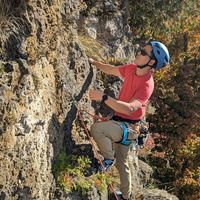
    So that was a good couple of days... Got my Foundation Coach done (thanks to Garland Mountaineering and some very patient students who hung around for me to make it to Exeter), then got to spend a chill evening with a friend (Mark), followed by a comfy sofa to sleep on and (better still) a trip to #Dewerstone today to send this rather fabulous VS, Leviathan, in a stunning setting.#climbing #TradClimbing #Trad #DevonClimbing