Skip to content

The Line: Nepali Climbers Exploring Nepal's Mountains

General News
1 1 84 1
  • A prominent trend in international climbing is the rise of local climbing communities and cultures around the world, not least in Nepal. As documented in Bernadette McDonald’s award-winning
    Alpine Rising
    book, Sherpas and other Nepali climbers, who long worked in the mountains only as skilled employees, now guide their own paying clients and, increasingly, go climbing for fun, with impressive results—the 2021

    first winter ascent of K2
    

    being the most dramatic example.
    The 2025 AAJ will have our biggest Nepal section in many years—at least 38 pages of new routes and exploration—and one reason is the number of Nepali climbers exploring their local mountains, from the first ascent of 6,750-meter Khumjungar to success on the huge south-southwest ridge of Cho Oyu after more than 40 years of attempts.

    Here, we’re sharing the story of a Nepali expedition to the remote and wild Kanjiroba Himal: Three 8,000-meter guides went on a post-work holiday adventure and succeeded on the first ascent of a 6,500-meter peak.

    In the premonsoon season of 2024, Nepali guides Vinayak Jaya Malla, Pasang Kami Sherpa, and Pasang Rinzee Sherpa worked commercial expeditions to 8,000-meter peaks. After returning to Kathmandu, they enjoyed only a few days of rest before heading to Jumla in West Nepal, arriving on June 4. They were perfectly acclimatized for the adventure ahead: the first ascent of the highest summit of the Patrasi group, situated on the western rim of the Kanjiroba Sanctuary, a trip partially sponsored by the Mount Everest Foundation. None of the climbers had previously trekked or climbed in the area.     
    Along with four helpers from Kathmandu, the team drove to Pere (2,700m) on June 5. Adding a local guide and three porters, they then walked four hard days via the Chaudhabise Valley to a base camp at 5,050 meters below the west side of the Patrasi group. Day three involved crossing the Tang Tang Pass (4,950m) and descending to an overnight camp at 4,100 meters in the Changda Valley, where they met an encampment of local people gathering yarsagumba (caterpillar fungus) for traditional Tibetan and Chinese medicine.
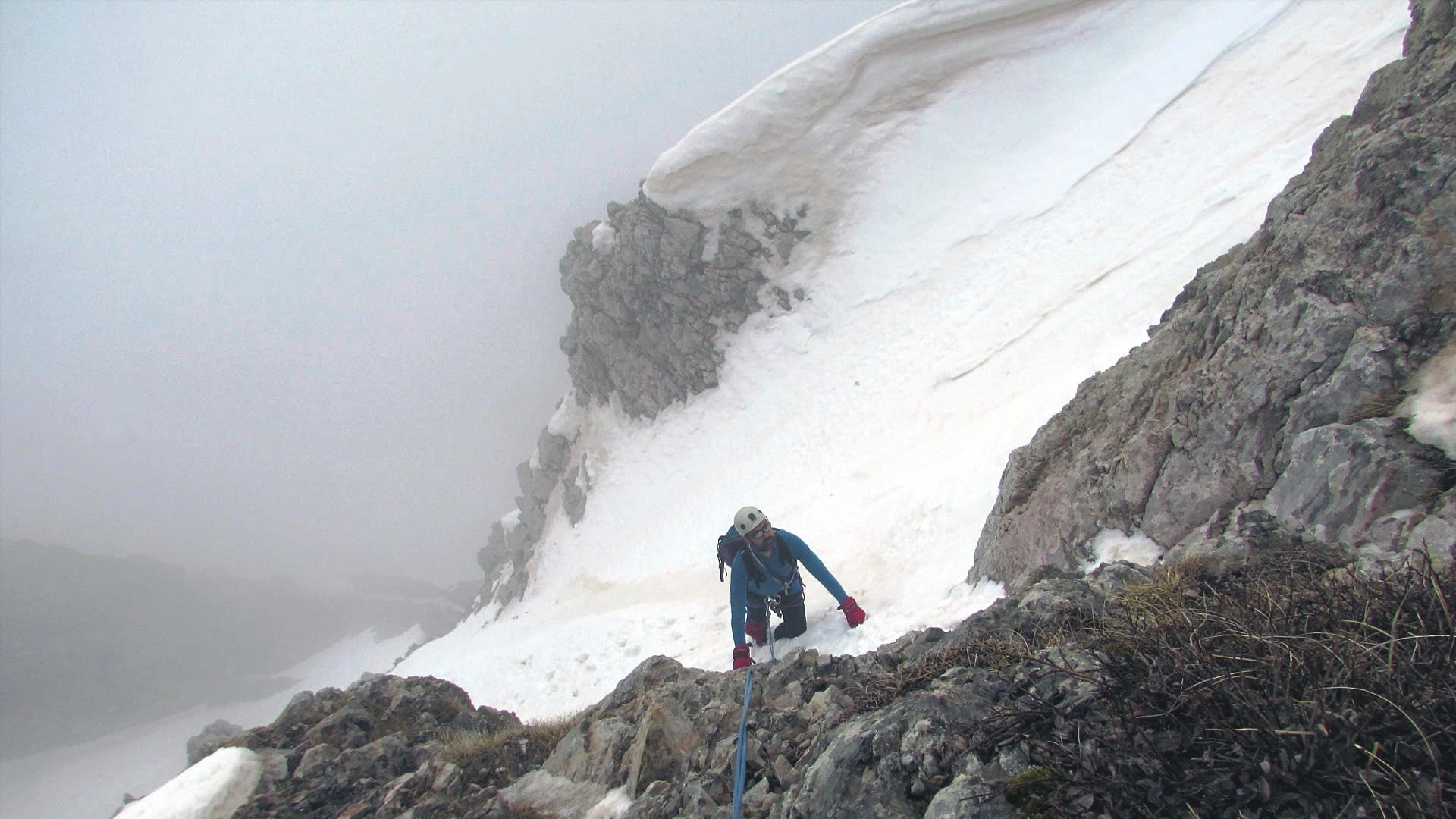
    At 8 a.m. on the 10th, they began their ascent of Patrasi. They first climbed a 200-meter snow couloir to reach the northwest ridge of Patrasi II (6,471m). After climbing 11 belayed pitches with rock to French 5a (around 5.8), and simul-climbing other sections, they reached 5,700 meters, where they were able to fashion a partial tent site. For safety, they slept that night in their harnesses.
    The following morning, they left at 5 a.m. After another 11 pitches (up to M4) and a little simul-climbing, they arrived at 6,000 meters, where they decided to pitch their second camp at around 4 p.m. The climbing had been quite challenging, in cold and windy conditions with intermittent snow showers. The rock was poor, and there were many places where protection points were 10 to 15 meters apart.
    At 4 a.m. on June 12, the three set out for a long summit push. Following the corniced ridge, then crossing a section of hard blue WI3, they reached the top of Patrasi II, descended a little to a snow slope, then headed up onto the left flank of the northeast ridge of Patrasi I. They reached the 6,521-meter summit at 4:35 p.m. in cloudy weather.
    The descent was long and tiring, with their muscles cramping toward the end of the day. Downclimbing and 15 long rappels (they climbed on 70-meter ropes) took them back to the 6,000-meter camp. It was 9:30 p.m., and they didn’t bother to cook, instead falling asleep very quickly.
    On the 13th, it took the trio almost 11 hours to descend all the way to base camp. By the 17th, they were back in Jumla. All equipment and nondegradable waste was packed out, and they left only five snow stakes, 10 pitons, and some cord on the mountain.
    Commenting on the trip, Pasang Kami Sherpa said, “This expedition added an interesting chapter to my mountaineering journey. It was in stark contrast to my experience on 8,000m peaks, where fixed rope, oxygen, well-stocked camps, and support systems are the norm. Here, we were on our own, a small team carrying only essential things, making our own decisions, and adapting to whatever ...


Suggested topics


  • The Line—Reward and Risk on Kaqur Kangri

    General News climbing
    1
    0 Votes
    1 Posts
    45 Views
    American Alpine ClubA
    Three teams will be honored with Piolets d’Or in Italy this December, and all three contributed feature articles about their climbs to the 2025 American Alpine Journal (AAJ). Tom Livingstone wrote about his and Aleš Česen’s new route on Gasherbrum III in Pakistan; Dane Steadman described the first ascent of Yashkuk Sar, also in Pakistan, with August Franzen and Cody Winckler; and Spencer Gray told the story of climbing the southwest arête of Kaqur Kangri in Nepal with Ryan Griffiths. There’s a lot to love about Spencer’s AAJ piece —it documents an amazing ascent. But we were also struck by the final passage, in which he reflects on the inherent and sometimes insidious risks of Himalayan alpinism. No one got hurt on the climb of 6,859-meter Kaqur Kangri, but afterward Spencer tallied 20-plus minor incidents that each could have ended very badly. Honest self-assessments like this are essential to a long life in the mountains, so we’ve shared Spencer’s thoughts here for readers to consider in light of their own climbing. Objectives like the southwest arête of Kaqur Kangri used to be what most climbing was: trying something kind of hard, an inconvenient distance from home, and relying on imagination as much as effort to turn a thing dreamt into a thing done. There are still plenty of places to contrive that same experience. We just have to look harder—and be willing to court risk in an unpredictable operating environment.  Our team didn’t have what we’d consider a close call, but in debriefing, I still counted 23 discrete times when the risk ticked up. A mule nearly broke my knee with a kick when I tried to bring it into camp one morning. On our first day of climbing, we hustled up a ramp that was probably at the outside edge of the ricochet zone of the upper serac band. Two days later, Ryan [Griffiths] and I both simultaneously realized that we were pushing our unroped luck on low-angle but hard-frozen talus above the west face. “If we slip here, it’s to the bottom, eh?” I said. Of four minor rockfall incidents, we mitigated two by our choice of protected belays and bivvies. Another was friendly fire: On rappel, I chucked a baseball-sized rock so the ropes wouldn’t dislodge it. But I misaimed, and the rock bounced down the snow slope and nailed Ryan in the shoulder. I reasoned that Ryan had probably done something in a prior life to deserve getting punched in the clavicle. He was less sure. On day three, below the snowfield, we pulled through suspended, stacked blocks in a roof that would have chopped the rope had they dislodged. On the upper headwall, my ice tool tethers got tangled behind a cam after I had campused out a diagonal rail. I couldn’t reverse the move, and I couldn’t continue until I had unthreaded the tools. Half growling, half screaming, I locked off on one arm, frontpoints screeching, and freed myself. When he followed, Ryan simply lowered out and jugged.  On the descent, Ryan and I had probably our riskiest moment when we crossed a 40-foot-wide wind slab partway down the upper northwest face. It appeared suddenly, a shallow pocket of cross-loaded danger in an otherwise stable snowpack. The tension on the slope and the soft, hollow thump as our boots and ice tools pressed through the snow put us both on edge. But with no other signs of failure or propagation, and a morning of downclimbing a similar aspect and angle above us, we each judged it safe enough to proceed. An hour before we regained the base of the mountain, fed up with navigating the messy corners of the final glacier, we briefly but obtusely committed to soloing steep glacial ice, embedded with crushed pebbles, as we traversed 15 feet above the bottom of a closed crevasse. We were spurred on by our friend Matt’s tiny light in the distance and the promise of fresh Snickers. Perhaps a week on the mountain and the tedious descent had dulled our nose for risk.  Three days later, we stopped at Chyargo La on the trek back out and took in our final view of Kaqur. I crouched beneath fluttering prayer flags to lounge against a rock, my fingers getting sticky pulling globs of gulab jamun out of a can we’d saved until now for a treat. Kaqur’s summit seracs glinted in the midday sun from what seemed like a very long ways away. Matt and Ryan laughed as I passed them the can for a shot of syrup to wash it all down. https://americanalpineclub.org/news/2025/11/18/the-linereward
  • 0 Votes
    1 Posts
    68 Views
    IFSCI
    https://www.youtube.com/watch?v=w8dQIt_dL0g
  • A beginner's or Intermediate choice?

    Videos climbing
    1
    0 Votes
    1 Posts
    86 Views
    EpicTVE
    https://www.youtube.com/watch?v=mcf5KQesMco
  • 0 Votes
    1 Posts
    95 Views
    UK ClimbingU
    The British Mountaineering Council (BMC) is delighted to announce the appointment of Dr Laura Needham as its new Head of Performance. https://www.ukclimbing.com/forums/t.php?n=775485
  • 0 Votes
    1 Posts
    113 Views
    climbingC
    We picked the following nine off-the-beaten-path destinations for their mellow scene, variety of climbing and aspects, historical atmospheric conditions, and—of course—autumnal beauty. https://www.climbing.com/places/9-secluded-fall-climbing-destinations/
  • 0 Votes
    1 Posts
    118 Views
    GrippedG
    https://gripped.com/news/all-woman-team-climbs-57-new-pitches-on-alpine-big-walls/
  • 0 Votes
    1 Posts
    179 Views
    climbingC
    Bernadette McDonald has spent her career celebrating communities the Western world has trained itself to ignore. Now, at 72, she’s tackled the most complex story of her life. https://www.climbing.com/people/bernadette-mcdonald-book-alpine-rising-review/
  • 0 Votes
    1 Posts
    126 Views
    ClimbingZineC
    A conversation with Taylor Luneau. Taylor discovered climbing after an injury derailed his ice hockey career. Taylor and Luke have a wide ranging conversation from local climbing organizations to the relationship of climate change and ice climbing, and much more. Plus in the outro is the premiere of the poem 5.6+ from the upcoming Microdose…<hr /><p><a href="https://climbingzine.com/from-the-ice-rink-to-the-ice-climb-with-taylor-luneau/">https://climbingzine.com/from-the-ice-rink-to-the-ice-climb-with-taylor-luneau/</a>