Skip to content

Seeking alpha testers for OpenBeta mobile app

Development
3 2 490 1
  • Do you rock climb, and also use an Android device? Do you want to try an alpha to get some beta? (har har har)

    ... via the OpenBeta Discord... we're seeking Android users to test drive the upcoming alpha release of the OpenBeta mobile app:

    I'm planning on making an internal Alpha release this week. If you have an Android device and would like to be included in this, please DM me your email so I can opt you in. We need at least 20 alpha testers to be eligible for public release so I encourage everyone to test the Alpha build if they can! — Vichy79

    If you're interested, simply DM Vichy79 on Discord, or reply here and I will pass on the message!

    In the meantime, here's a screenshot of what the image viewer looks like in-app. Pretty slick!
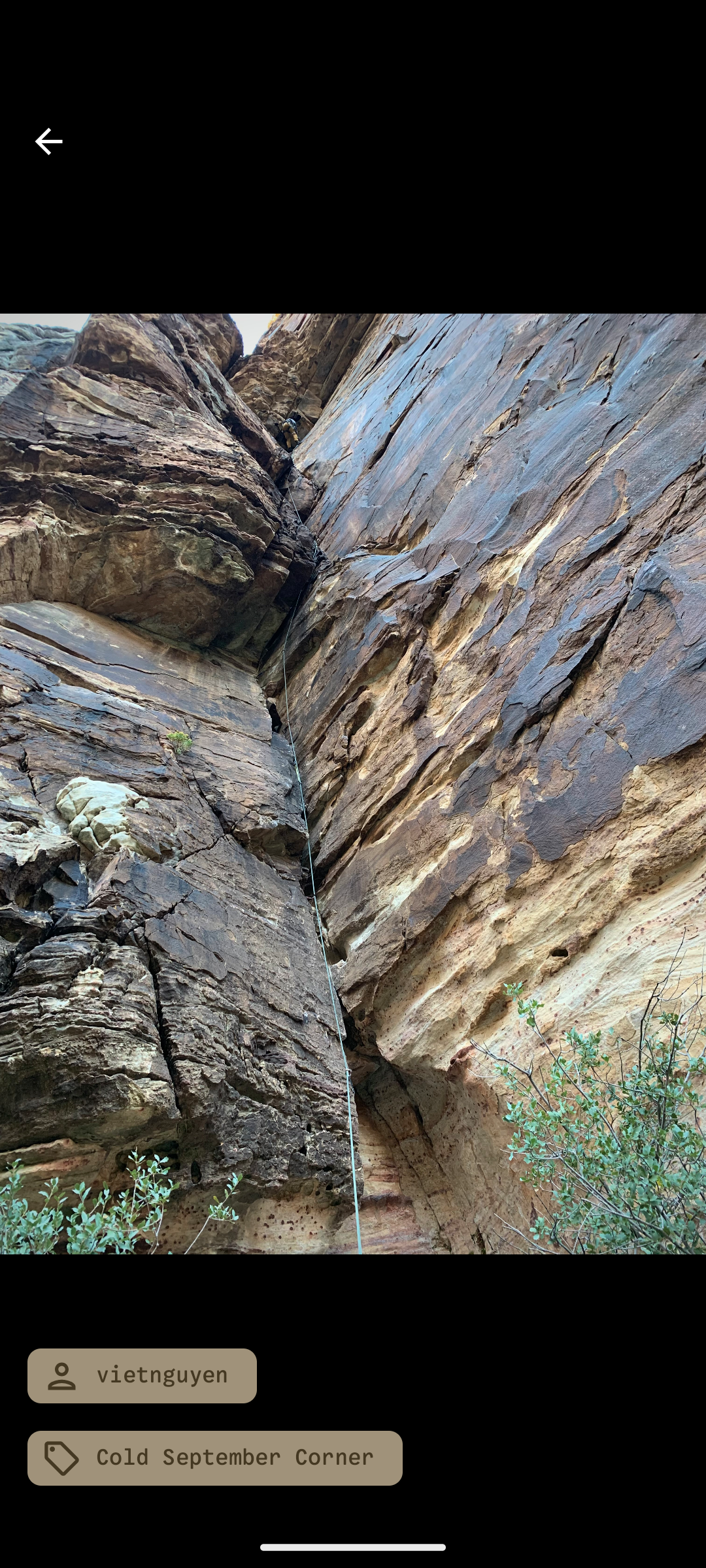
    Screenshot_20241103-125507.png

    You can also join our OpenBeta Discord here.

    P.S. Did you know we just did a volunteer spotlight on Vincent? Check it out!

  • I'm excited for the OpenBeta mobile app!

  • I'm excited for the OpenBeta mobile app!

    @bean Likewise! The local route devs in my area all send their guidebooks up to Rakkup, whose app is... erm... passable... at best.

    I'd love to be able to find and tick climbs directly from my phone at the crag.

  • BohwaZB BohwaZ shared this topic on

Suggested topics


  • 0 Votes
    1 Posts
    2 Views
    GrippedG
    DIY floating dock helps climbers send new problems in Boulder Canyon The post Say “No” to Shallow-Water Soloing with This Inflatable Crash-Pad Barge appeared first on Gripped Magazine. https://gripped.com/news/say-no-to-shallow-water-soloing-with-this-inflatable-crash-pad-barge/
  • Janja Garnbret Climbs Three V13s in a Session

    General News climbing
    1
    0 Votes
    1 Posts
    39 Views
    GrippedG
    The feat is no big deal for Garnbret who has her sights on bigger projects in Switzerland The post Janja Garnbret Climbs Three V13s in a Session appeared first on Gripped Magazine. https://gripped.com/news/janja-garnbret-climbs-three-v13s-in-a-session/
  • 0 Votes
    1 Posts
    45 Views
    IFSCI
    https://www.youtube.com/watch?v=2NiNvyyyZWI
  • 0 Votes
    1 Posts
    82 Views
    IFSCI
    https://www.youtube.com/watch?v=1ZGznUMO3TI
  • Guidebook XV—Policy Spotlight

    General News climbing
    1
    0 Votes
    1 Posts
    69 Views
    American Alpine ClubA
    Consider the following true story: It’s the mid-2000s and two friends are on a long, multi-pitch sport climb. They’re excited—it is the climbing vacation to paradise they’ve dreamt about. They’ve been on clean, hard limestone all week. They’re prepared and plenty experienced for this climb. The leader has reached a belay stance and is getting ready to bring up their partner. They are building an anchor on two shiny new bolts. As the leader flakes the rope, they see the first bolt on the next pitch is close, and they decide to clip the rope into it—giving their partner a little more of a top-rope in the last moves and setting them up for swinging into the next pitch. The follower gets to the anchor and clips in. What a climb! They both lean back to laugh. Both anchor bolts break. They fall. Only that extra bolt on the next pitch holds, keeping them from dying, but all three bolts were shiny and brand new. Corrosion isn’t always visible, and there are a few different kinds of severe corrosion that result in scary failures like the one described above. These have been known for a long time in industries like construction and nuclear power, but it has only been in the last 20 years or so that we’ve recognized them in climbing anchors. These failures don’t require a lot of corrosion, just a very small amount. The two main types are Stress Corrosion Cracking (SCC) and Sulfur Stress Cracking (SSC), but there are others as well. For a number of reasons, these are really terrifying problems in climbing safety: they can happen very quickly without any easy-to- spot outward signs; they are difficult to predict; and they happen on stainless steels that climbers and route developers commonly think of as bomber. Like in any other part of climbing, assumptions can kill. Starting in the late 1990s, climbers started talking about this issue. The problem seemed particularly obvious in coastal climbing areas, but it began to crop up elsewhere as well. Companies were quietly adjusting the alloying content of their wedge bolts, scientific papers were being written, and developers were beginning to use glue-ins and titanium. And ultimately, the Union Internationale des Associations d’Alpinisme (UIAA) Safety Commission (SafeComm) started looking into the issue in a rigorous way. The UIAA is where the buck stops with global climbing safety. It is a union of climbing federations from 73 countries that works on things like mountain medicine, protecting climbing areas globally, organizing Ice Climbing World Cups, and standardizing training curricula and safe practices. It is where gear failure from all countries gets analyzed. It is where climbers, manufacturers, and labs come together to make climbing safer. As the national organization for climbers in America, the American Alpine Club is the U.S. representative to the UIAA. To address the SCC issue, the SafeComm worked for almost 15 years to develop a new Rock Anchor Standard that tests the complete anchor—UIAA123. In the summer of 2025, we updated it at our 50th anniversary meeting with guidance on welding. SCC starts with a pit on the surface of the material. This could be a small defect in the steel, damage caused by placing the bolt, or something left over from manufacturing. Pitting corrosion can also start the process. Pitting corrosion causes deepening pits to form in the surface and is typically fueled by the presence of chlorine. In all these types of corrosion, chlorine isn’t consumed, it is just something that facilitates the corrosion’s progress. That means it doesn’t take very much to make this happen—a high concentration, but not a large amount. Once there is a deep enough pit, the process changes—in some cases it will stop here, but in others, the corrosion will develop into SCC and a crack will begin to extend from the bottom of the pit. This crack drives forward through the shaft of the bolt via a complex mechanism that doesn’t cause the outside of the bolt to corrode. In a short time, the bolt could break with body weight but show little sign of this danger. Sulfur Stress Cracking (SSC) is similar in effect, but not in process. For now, we’ll focus on SCC. Stress Corrosion Cracking requires three things: a susceptible material, a suitable environment, and sufficient stress in the material. None of these things are quite as straight-forward as they seem and the rate of cracking can ... https://americanalpineclub.org/news/2025/8/14/guidebook-xvpolicy-spotlight
  • 0 Votes
    1 Posts
    168 Views
    IFSCI
    https://www.youtube.com/watch?v=6geKlxCrxPc
  • Could you survive with just 2 carabiners?

    Videos climbing hownot2
    1
    0 Votes
    1 Posts
    107 Views
    HowNOT2H
    https://www.youtube.com/watch?v=PG7W83zHowQ
  • OAC 2022 AGM Recording

    Ontario climbing ontario
    1
    0 Votes
    1 Posts
    200 Views
    O
    https://www.ontarioallianceofclimbers.ca/2022/11/16/oac-2022-agm-recording/