DMM Pivot for lowering to ground via top belay?
General Climbing
12
Posts
4
Posters
814
Views
1
Watching
-
Last weekend I took a couple friends to the local crag for their first time out.
Since I was the only one able to clean, others led and set the anchor, but on occasion if the leader were unable to reach the anchors, I would set the anchor and belayed the others up from the top using a grigri. That worked pretty well, though I'm aware that Petzl doesn't recommend using the grigri in such a manner (a redirected belay is preferred.)
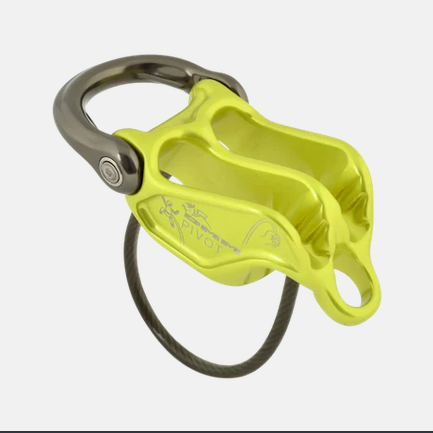
I did notice that the DMM Pivot set up in guide/auto-blocking mode had a dedicated method for lowering — using a second biner to adjust the angle of the device. Are there concerns with doing so for lowering a second climber all the way to the ground?
Whenever lowering is mentioned, it's always in the context is lowering the second "a few feet" or so.
-
Last weekend I took a couple friends to the local crag for their first time out.
Since I was the only one able to clean, others led and set the anchor, but on occasion if the leader were unable to reach the anchors, I would set the anchor and belayed the others up from the top using a grigri. That worked pretty well, though I'm aware that Petzl doesn't recommend using the grigri in such a manner (a redirected belay is preferred.)
I did notice that the DMM Pivot set up in guide/auto-blocking mode had a dedicated method for lowering — using a second biner to adjust the angle of the device. Are there concerns with doing so for lowering a second climber all the way to the ground?
Whenever lowering is mentioned, it's always in the context is lowering the second "a few feet" or so.
@devnull Short answer is "Yes".
Guide mode belay devices released by a 'biner are largely, due to the way the blocking works, an on/off proposition when it comes to the braking applied to the rope - it's very hard/all but impossible to control the lower well especially over long distances. In the "braking off" position, you're relying increasingly on strength for control, which gets worse the heavier the climber. There are various ways to mitigate this, but it required quite a bit of knowledge and practice to do safely.
This is not to say it's impossible to fully lower in guide mode, but not a great option. -
@devnull Short answer is "Yes".
Guide mode belay devices released by a 'biner are largely, due to the way the blocking works, an on/off proposition when it comes to the braking applied to the rope - it's very hard/all but impossible to control the lower well especially over long distances. In the "braking off" position, you're relying increasingly on strength for control, which gets worse the heavier the climber. There are various ways to mitigate this, but it required quite a bit of knowledge and practice to do safely.
This is not to say it's impossible to fully lower in guide mode, but not a great option.@jcmchammy@mountains.social thank you so much for the detailed response, that's very helpful!
Let's say you're in a single pitch context where your follower wasn't able to get past a crux, etc., would you then switch to a redirected belay to lower? 3:1 haul?
-
@jcmchammy@mountains.social thank you so much for the detailed response, that's very helpful!
Let's say you're in a single pitch context where your follower wasn't able to get past a crux, etc., would you then switch to a redirected belay to lower? 3:1 haul?
@devnull If you're confident to do both of those things, then dealer's choice. On balance, I'd probably pick up rather than down given cruxes are typically a few moves (here I'm kinda assuming you're not totally sandbagging your second with a route they have no chance of sending
 ). TBH before either of those things, I'd probably start by maybe sticking a prussic on for some leverage and see if I could aid my climber past the crux with a bit of extra support.
 -
To add to this, simply said: if you pull on the device with a biner it will suddenly release and your climber will plummet. You need a backup before doing this.
-
@devnull If you're confident to do both of those things, then dealer's choice. On balance, I'd probably pick up rather than down given cruxes are typically a few moves (here I'm kinda assuming you're not totally sandbagging your second with a route they have no chance of sending
). TBH before either of those things, I'd probably start by maybe sticking a prussic on for some leverage and see if I could aid my climber past the crux with a bit of extra support.@jcmchammy@mountains.social thanks, I wish I'd thought of that over the weekend!
I will admit that lowering on the grigri (after redirecting the brake strand upward) was very convenient. I guess I was hoping to find a silver bullet from among the surprisingly vast field of belay devices.
(Ontario is grigri country heh)
-
To add to this, simply said: if you pull on the device with a biner it will suddenly release and your climber will plummet. You need a backup before doing this.
-
@daanschone@pixelfed.social right! A prussik on the brake strand is definitely seems mandatory here.
 Often a munter hitch behind the reverso/atc is used to lower a climber.
 -
Last weekend I took a couple friends to the local crag for their first time out.
Since I was the only one able to clean, others led and set the anchor, but on occasion if the leader were unable to reach the anchors, I would set the anchor and belayed the others up from the top using a grigri. That worked pretty well, though I'm aware that Petzl doesn't recommend using the grigri in such a manner (a redirected belay is preferred.)
I did notice that the DMM Pivot set up in guide/auto-blocking mode had a dedicated method for lowering — using a second biner to adjust the angle of the device. Are there concerns with doing so for lowering a second climber all the way to the ground?
Whenever lowering is mentioned, it's always in the context is lowering the second "a few feet" or so.
@devnull
As @jcmchammy already mentioned, lowering from guide mode is not that easy.
The YouTube channel JB Mountain Skills has a video of different options.
But as JC said, practice first with a trainer who knows the topic.I would also say, that adding a pulley construct with a prusik + carabiner to the existing guide mode setup is easier and more efficient.
You are then able to give the climber a bit of pull to get over the crux.
Especially useful in multipich scenarios. -
@jcmchammy@mountains.social thank you so much for the detailed response, that's very helpful!
Let's say you're in a single pitch context where your follower wasn't able to get past a crux, etc., would you then switch to a redirected belay to lower? 3:1 haul?
Easiest is to leave the device in guide mode and use it as progress capturing while hauling. You can try to attach yourself with a prusik on the brake strand and weight it with your body, while pulling on the climber's side of the rope. For passing a crux this should be enough. -
@jcmchammy@mountains.social thank you so much for the detailed response, that's very helpful!
Let's say you're in a single pitch context where your follower wasn't able to get past a crux, etc., would you then switch to a redirected belay to lower? 3:1 haul?
If you'd want to lower, this is a bit too complicated for a social media post. Maybe you can find something on youtube -
@jcmchammy@mountains.social thank you so much for the detailed response, that's very helpful!
Let's say you're in a single pitch context where your follower wasn't able to get past a crux, etc., would you then switch to a redirected belay to lower? 3:1 haul?
And of course the climber can also prusik or jug up the rope.