Skip to content

The Prescription—Fall on Rock

General News
1 1 131 1
  • This July, we look back at an accident in 2019. A climber took a serious lead fall while clipping the third bolt on a popular sport route in North Carolina called Chicken Bone (5.8). This climber made a fairly common error when his rope crossed behind his leg while climbing. This oversight resulted in serious injury from what should have been a routine fall.    
    During the afternoon of May 6, Ranger J. Anderson received a call reporting a fallen climber. When Anderson found the patient, Matthew Starkey, he was walking out, holding a shirt on the right side of his head and covered in blood. However, he was conscious and alert. After ensuring the patient’s condition did not worsen, Anderson accompanied him on the hike. Medical assessment revealed a two-to three-inch laceration on the right side of his skull and light rope burns on his leg.
    Starkey explained to rescuers that he had been lead climbing outdoors for his first time on the route Chicken Bone (5.8 sport). As he was nearing the third bolt, he lost his grip on a hold and fell. His rope was behind his leg, and this caused him to flip upside down and hit his head on a ledge below. Starkey said he was unsure, but felt like he had “blacked out.” He was not wearing a helmet.

    (Source: Incident Report from Pilot Mountain State Park.)

    Many of us have fallen and had the rope catch behind our leg. Usually, we get nothing more than a bad rope burn. Unfortunately, there can be severe consequences if we get a hard catch, flip upside down, and strike our head.
    Pete Takeda, Editor of Accidents in North American Climbing, is back with some advice on how to fall correctly.

    Pete Takeda, Editor of Accidents in North American Climbing; Katie Ferguson, Executive Assistant; Producers: Shane Johnson and Sierra McGivney; Videographer: Foster Denney; Editor: Sierra McGivney. Location: Canal Zone, Clear Creek Canyon, CO.

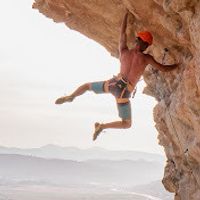
    Avoid getting your feet and legs between the rock and the rope. A fall in this position may result in the leg snagging the rope and flipping the climber upside down.
    While many sport leaders pass on wearing a helmet, this accident is a good example of its usefulness. Leading easier climbs can increase the risk for injury, as they often tend to be lower angle and/or have ledges that a falling climber could hit. (Source: The Editors.)
    Editor’s Note: This was Starkey’s first outdoor climbing lead, and his lack of experience perhaps contributed to the accident.
    Lead climbing carries inherent dangers regardless of the grade and amount of protection. Popular moderates might be more perilous than notoriously dangerous routes, as climbers can be more easily caught unawares on “easy” and well-protected terrain.


Suggested topics


  • 0 Votes
    1 Posts
    133 Views
    GrippedG
    While The State of Water isn't pulled from shelves, the Trump administration flagged it as "negative" content The post U.S.A. Government Effectively Bans Book About Water from Yosemite appeared first on Gripped Magazine. https://gripped.com/gripped-outdoors/u-s-a-government-effectively-bans-book-about-water-from-yosemite/
  • Satone Yoshida Climbs Biographie 5.15a

    General News climbing
    1
    0 Votes
    1 Posts
    111 Views
    GrippedG
    This was the 21 year old's first route harder than 5.14c The post Satone Yoshida Climbs Biographie 5.15a appeared first on Gripped Magazine. https://gripped.com/news/satone-yoshida-climbs-biographie-5-15a/
  • Guidebook XIV—Member Spotlight

    General News climbing
    1
    0 Votes
    1 Posts
    167 Views
    American Alpine ClubA
    Spacewalking outside the Hubble Space Telescope, John Grunsfeld wasn’t that much closer to the stars than when he was back on the surface of Earth, but it certainly felt that way. The sensation of spacewalking, of constantly being in freefall, but orbiting Earth fast enough that it felt like weightlessness, was more of a thrill than terrifying. Looking out to the vaster universe, seeing the moon in its proximity, the giant body of the sun, stole his breath away. Grunsfeld was experiencing a sense of exploration that very few humans get to. It was deeply moving, a sensation he also got in the high glaciated ranges when he’d look around and be surrounded by crevasses and granite walls of rock and ice. Throughout his life, he couldn’t help but seek out the most inhospitable places on the planet, and even beyond. You might think that there is nothing similar between climbing and spacewalking. But when you ask John Grunsfeld, former astronaut and NASA Chief Scientist—and an AAC member since 1996—about the similarities, the connections are potent. The focus required of spacewalking and climbing is very much the same, Grunsfeld says. Just like you can’t perform at your best on the moves of a climb high above the ground without intense focus on the next move and the currents of balance in your body, so, too, suited up in the 300-pound spacesuit, with 4.3 pounds per square inch of oxygen, and 11 layers of protective cloth insulation, you still have to be careful not to bump the space shuttle, station, or telescope as you go about the work of repairing and updating such technology—the job of the mission in the first place. Outside the astronaut’s suit is a vacuum, and Grunsfeld is not shy about the stakes. “Humans survive seconds when vacuum-exposed,” he says. With such high risks, it’s a shame that the AAC rescue benefit doesn’t work in space. Not only is spacewalking, like climbing, inherently dangerous, it also requires intense focus, and it can be a lot like redpointing. Grunsfeld reflects that “it’s very highly scripted. Every task that you’re going to do is laid out long before we go to space. We practice extensively.” In Grunsfeld’s three missions to the Hubble Space Telescope, his spacewalks were a race against the clock—the battery life and limited oxygen that the suit supplied versus the many highly technical tasks he had to perform to update the Hubble instruments and repair various electronic systems. It’s about flow, focus, and execution—skills and a sequence of moves that he had practiced again and again on Earth before coming to space. Similarly, tether management is critical. Body positioning, and not getting tangled in the tether, is important in order to not break something—say, kick a radiator and cause a leak that destroys Hubble and his fellow astronauts inside. But to Grunsfeld, the risk is worth it. The Hubble Space Telescope is “the world’s most significant scientific instrument and worth billions of dollars. Thousands of people are counting on that work.” Indeed, perhaps a little more is at stake than a send or a summit. Growing up in Chicago, Grunsfeld’s mind first alighted on the world of science and adventure through the National Geographic magazines he devoured, and a school project that had an outsized effect. Grunsfeld’s peers were assigned to write a brief biography of people like George Washington and Babe Ruth. Rather than these more familiar figures, Grunsfeld was assigned to research the life of Enrico Fermi—a nuclear physicist who was instrumental in the Manhattan Project, the creator of the world’s first artificial nuclear reactor, and a lifelong mountaineer. Suddenly, science and the alpine seemed deeply intertwined. Grunsfeld started climbing as a teenager, top-roping in Devil’s Lake, back when the cutting edge of gear innovation meant climbing by wrapping the rope around your waist and tying it with a bowline. Attending a NOLS trip to the Wind River Range and further expanding on his rope and survivor skills truly cemented his love of climbing in wild spaces. Throughout the years, climbing was a steady beat in his life, a resource for joy. He would climb in Lumpy Ridge, the Sierra, the White Mountains of New Hampshire, Tahquitz, Peru, Bolivia, and many other places with his wife, Carol, his daughter, and close friends like Tom Loeff, another AAC member. If climbing was a steady beat, his fascination with space and astrophysics would be a starburst. At first, his application to become a NASA astronaut was denied, but in 1992, Grunsfeld joined the NASA Astronaut Corps. It would shape the rest of his life’s work. Between 1... https://americanalpineclub.org/news/2025/5/19/guidebook-xivmember-spotlight
  • Sungsu Lee Climbs 6 V15s and a 5.15 in 2024

    General News climbing
    1
    0 Votes
    1 Posts
    164 Views
    GrippedG
    He finished his strong year with a repeat of Lucid Dreaming V15 this week The post Sungsu Lee Climbs 6 V15s and a 5.15 in 2024 appeared first on Gripped Magazine. https://gripped.com/uncategorized/sungsu-lee-climbs-6-v15s-and-a-5-15-in-2024/
  • Highland MP Calls for Rural 4G Network Rethink

    General News climbing
    1
    0 Votes
    1 Posts
    176 Views
    UK ClimbingU
    Jamie Stone, MP for Caithness, Sutherland and Easter Ross, has met the Minister of State for Data Protection and Telecoms, to ask him to suspend the geographical target for the Shared Rural Network. It's something that conservationists and loca... https://www.ukclimbing.com/forums/t.php?n=776766
  • 0 Votes
    1 Posts
    171 Views
    UK ClimbingU
    Austrian Babsi Zangerl has made the first-ever flash ascent of a route on Yosemite's El Capitan, climbingFreerider 5.13a via the Boulder Problemin a three-day push with no falls. Her ascent comes just a few weeks after she repeated one of Yosemite's hardest single-pitch trad routes, Magic Line 8c+ at Vernal Falls. https://www.ukclimbing.com/forums/t.php?n=776691
  • Take Access Fund’s 2024 Climber Survey!

    General News climbing
    1
    1 Votes
    1 Posts
    146 Views
    climbingC
    https://www.climbing.com/news/access-fund-survey-2024/
  • Fri Night Vid Stefano Ghisolfi attempts Silence, 9c

    General News climbing
    1
    0 Votes
    1 Posts
    157 Views
    UK ClimbingU
    https://www.ukclimbing.com/forums/t.php?n=771691