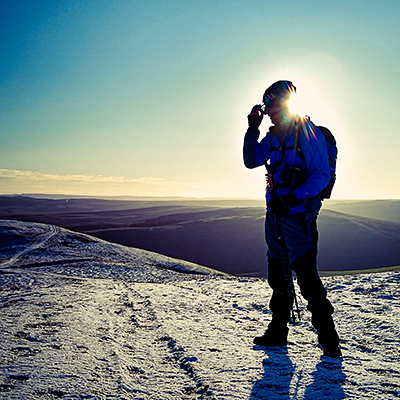
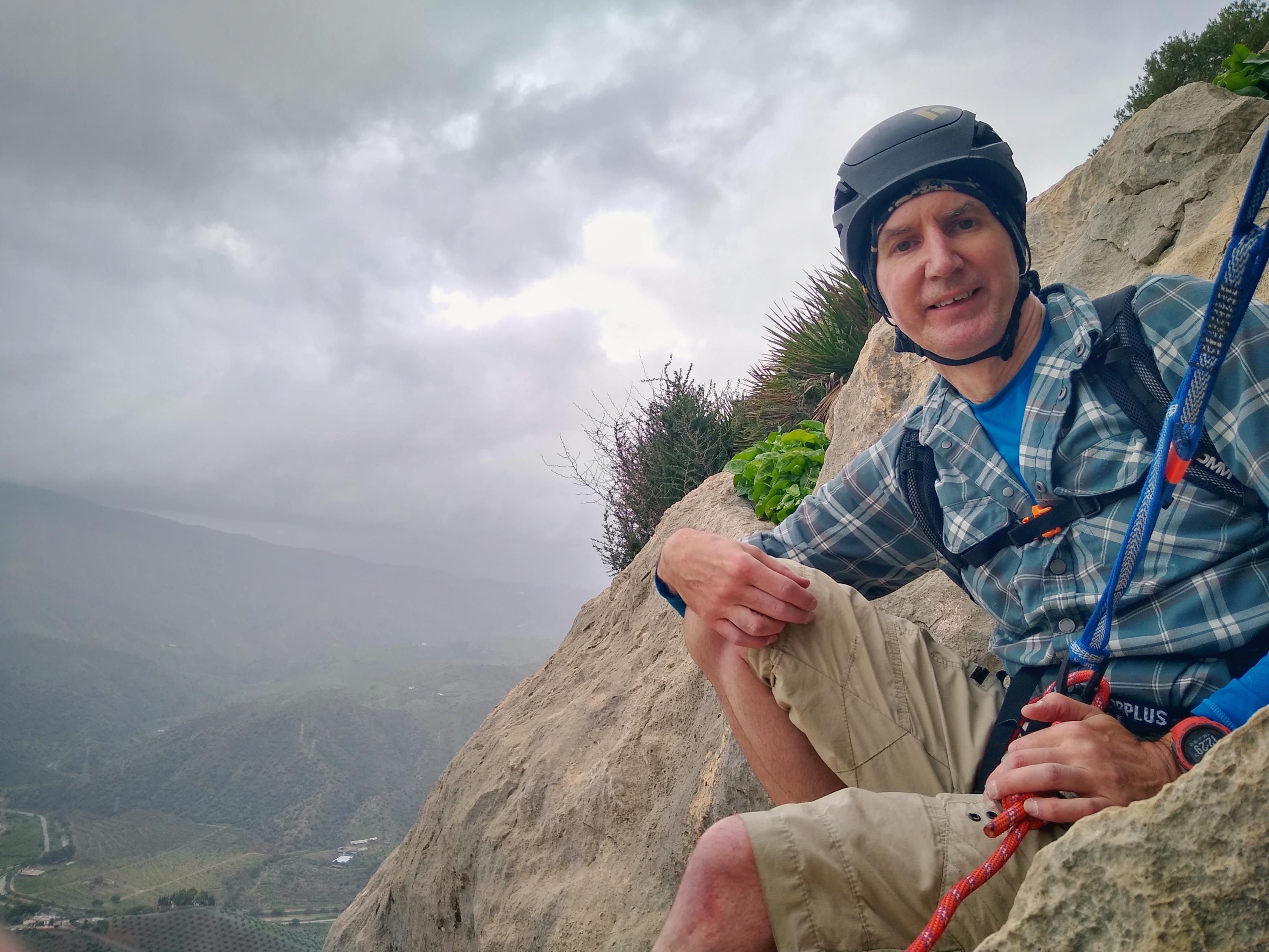
Guidebook XIV—Member Spotlight
-
Spacewalking outside the Hubble Space Telescope, John Grunsfeld wasn’t that much closer to the stars than when he was back on the surface of Earth, but it certainly felt that way. The sensation of spacewalking, of constantly being in freefall, but orbiting Earth fast enough that it felt like weightlessness, was more of a thrill than terrifying. Looking out to the vaster universe, seeing the moon in its proximity, the giant body of the sun, stole his breath away. Grunsfeld was experiencing a sense of exploration that very few humans get to. It was deeply moving, a sensation he also got in the high glaciated ranges when he’d look around and be surrounded by crevasses and granite walls of rock and ice. Throughout his life, he couldn’t help but seek out the most inhospitable places on the planet, and even beyond.
You might think that there is nothing similar between climbing and spacewalking. But when you ask John Grunsfeld, former astronaut and NASA Chief Scientist—and an AAC member since 1996—about the similarities, the connections are potent.
The focus required of spacewalking and climbing is very much the same, Grunsfeld says. Just like you can’t perform at your best on the moves of a climb high above the ground without intense focus on the next move and the currents of balance in your body, so, too, suited up in the 300-pound spacesuit, with 4.3 pounds per square inch of oxygen, and 11 layers of protective cloth insulation, you still have to be careful not to bump the space shuttle, station, or telescope as you go about the work of repairing and updating such technology—the job of the mission in the first place. Outside the astronaut’s suit is a vacuum, and Grunsfeld is not shy about the stakes. “Humans survive seconds when vacuum-exposed,” he says. With such high risks, it’s a shame that the AAC rescue benefit doesn’t work in space.
Not only is spacewalking, like climbing, inherently dangerous, it also requires intense focus, and it can be a lot like redpointing. Grunsfeld reflects that “it’s very highly scripted. Every task that you’re going to do is laid out long before we go to space. We practice extensively.” In Grunsfeld’s three missions to the Hubble Space Telescope, his spacewalks were a race against the clock—the battery life and limited oxygen that the suit supplied versus the many highly technical tasks he had to perform to update the Hubble instruments and repair various electronic systems. It’s about flow, focus, and execution—skills and a sequence of moves that he had practiced again and again on Earth before coming to space. Similarly, tether management is critical. Body positioning, and not getting tangled in the tether, is important in order to not break something—say, kick a radiator and cause a leak that destroys Hubble and his fellow astronauts inside. But to Grunsfeld, the risk is worth it. The Hubble Space Telescope is “the world’s most significant scientific instrument and worth billions of dollars. Thousands of people are counting on that work.”
Indeed, perhaps a little more is at stake than a send or a summit.
Growing up in Chicago, Grunsfeld’s mind first alighted on the world of science and adventure through the National Geographic magazines he devoured, and a school project that had an outsized effect. Grunsfeld’s peers were assigned to write a brief biography of people like George Washington and Babe Ruth. Rather than these more familiar figures, Grunsfeld was assigned to research the life of Enrico Fermi—a nuclear physicist who was instrumental in the Manhattan Project, the creator of the world’s first artificial nuclear reactor, and a lifelong mountaineer. Suddenly, science and the alpine seemed deeply intertwined.
Grunsfeld started climbing as a teenager, top-roping in Devil’s Lake, back when the cutting edge of gear innovation meant climbing by wrapping the rope around your waist and tying it with a bowline. Attending a NOLS trip to the Wind River Range and further expanding on his rope and survivor skills truly cemented his love of climbing in wild spaces. Throughout the years, climbing was a steady beat in his life, a resource for joy. He would climb in Lumpy Ridge, the Sierra, the White Mountains of New Hampshire, Tahquitz, Peru, Bolivia, and many other places with his wife, Carol, his daughter, and close friends like Tom Loeff, another AAC member.
If climbing was a steady beat, his fascination with space and astrophysics would be a starburst. At first, his application to become a NASA astronaut was denied, but in 1992, Grunsfeld joined the NASA Astronaut Corps. It would shape the rest of his life’s work. Between 1...
Guidebook XIV—Member Spotlight — American Alpine Club
No Mountain High Enough The Intersections between Space Travel and High-Altitude Mountaineering Member Spotlight: Dr. John Grunsfeld, Astronaut By Hannah Provost Spacewalking outside the Hubble Space Telescope, John Grunsfeld wasn’t that much closer to the stars than when he was back on the s
American Alpine Club (americanalpineclub.org)



Hello! It looks like you're interested in this conversation, but you don't have an account yet.
Getting fed up of having to scroll through the same posts each visit? When you register for an account, you'll always come back to exactly where you were before, and choose to be notified of new replies (either via email, or push notification). You'll also be able to save bookmarks and upvote posts to show your appreciation to other community members.
With your input, this post could be even better 💗
Register Login