Skip to content

Bouldering Pad Carnage: Falls, Melons, and Arrows! | The Climbing Science Show - EP2

Videos
1 1 133 1

Suggested topics


  • 0 Votes
    1 Posts
    75 Views
    GeoffreyK
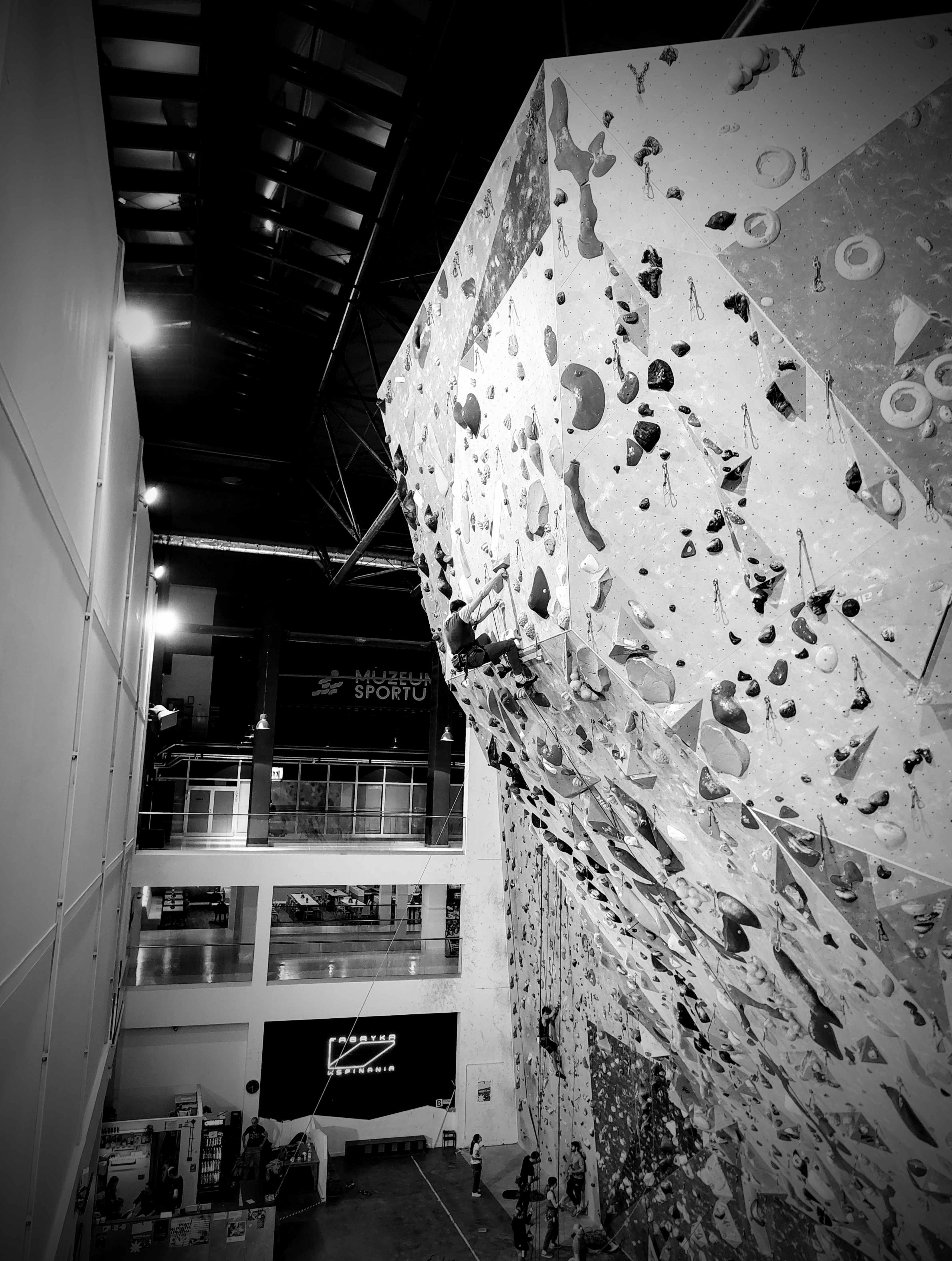
    cavernous, łódź, nov 2025 I had a previous shot from the same position (in Zatoka Sportu at the Lodz Polytechnic University) on here somewhere, but lately they decided to put that wall to the left in. esthetically not that ideal as previously the building felt light and airy, while now it feels cramped despite all the space. I assume it had more to do with the noise from either side of the wall though. #climbing #photography #monochrome #blackandwhite
  • The Prescription—Anchor Failure

    General News climbing
    1
    0 Votes
    1 Posts
    117 Views
    American Alpine ClubA
    This month we feature an accident that occurred in 2024 on Yosemite’s Manure Pile Buttress when a climber mistied a knot. You can reference this accident in this years Accidents in North American Climbing (page 46). The knot involved was bulky and involved multiple strands of webbing, brought together to tie a single anchor loop. The average climber only needs to know several simple knots but sometimes, even experts can get it wrong. This climber was lucky and escaped with minor injuries. On June 24, 2024 during the American Alpine Club’s United in Yosemite Climbing Festival, a climber led the first pitch of After Six (5.7). At the belay tree, they set up a lowering anchor using a knot on a quad-length sling with two locking carabiners. The climber weighted the rope and lowered. He cleaned the top piece of gear (a camming device). Below, a second cam proved too tight to remove so he unclipped it. The climber continued to lower. At the third piece from the top, the anchor knot failed. The climber fell 80 feet before the belayer caught his fall, when the climber was about five feet above the ground. The climber was lowered and SAR was called. His injuries included a sprained ankle, lacerations on the face, a broken nose, and rope burns on the hands and fingers.  A slipknot looks deceptively like other knots you'd use in a climbing anchor, but when you actually load it, it's not going to hold much at all. Pete Takeda, Editor of Accidents in North American Climbing, and IFMGA/AMGA Guide Jason Antin, are back to explain how a slipknot can have serious consequences when used in climbing anchors. Credits: Pete Takeda, Editor of Accidents in North American Climbing; IFMGA/AMGA Guide Jason Antin; Producers: Shane Johnson and Sierra McGivney; Videographer: Foster Denney; Editor: Sierra McGivney; Location: Accessibility Crag, Clear Creek, CO. The climber was fortunate that he had high protection that stopped him from hitting the ground when the anchor failed and lots of slack was introduced into the belay system. The anchor sling was found with an intact overhand knot. The belayer, who wishes to remain anonymous, wrote to ANAC: “We believe it was an attempted overhand knot but it was actually a slipknot.” The still-locked masterpoint carabiners were found clipped to the rope by the fallen climber.  *Editor’s Note: After analysis, it was determined that the climber had attempted to tie an overhand knot but failed to pull the two end strands completely through the knot. He then clipped the two locking carabiners through the unsecured loops. Since there were so many strands of webbing in the mix, it was hard to tell the difference between a fixed loop and a slip loop. When weighted, the slip loops had sufficient friction and compression to hold, if only momentarily, while the ends gradually crept toward release. (Sources: Anonymous and ANAC Canada Editor Robert Chisnall.) https://americanalpineclub.org/news/2025/11/12/the-prescription
  • 0 Votes
    1 Posts
    155 Views
    IFSCI
    https://www.youtube.com/watch?v=3p5aXjy2aFI
  • 0 Votes
    1 Posts
    151 Views
    IFSCI
    https://www.youtube.com/watch?v=vOj1usWKItY
  • The Line: Ascents for the Ages

    General News climbing
    1
    0 Votes
    1 Posts
    193 Views
    American Alpine ClubA
    Babsi Zangerl’s flash ascent of Free Rider on El Capitan in November—the first flash of any El Cap big-wall free route—was a highlight of the year in climbing. In the new Cutting Edge podcast, the 36-year-old Austrian climber describes her preparation, fears, and the intense effort of her no-falls ascent of the 5.13a wall. Plus, Alex Honnold, Josh Wharton, and AAJ editor Dougald MacDonald add personal perspective and context on Babsi’s historic Free Rider ascent. Listen to the new episode here! Two of the most accomplished and adventurous climbers of the modern era are Mick Fowler, a retired tax inspector for Great Britain’s revenue department, and Victor Saunders, a U.K. architect turned Chamonix mountain guide. The two completed their first major new route in Pakistan together 37 years ago. This past autumn, Fowler, now age 68, and Saunders, 74, completed another big new route: the first ascent of a 6,258-meter peak, also in Pakistan. Read on to learn more about both climbs. In September 2024, Victor Saunders and I made the first ascent of Yawash Sar I (6,258m), a shapely peak at the head of the Koksil (a.k.a. Shop Dur) Glacier in the Ghujerab Mountains, very near the frontier with China. [In 2022, a British team made three attempts on the south face and southern ridges of Yawash Sar I, on the opposite side of the mountain. (See AAJ 2023.) No prior attempt from the Koksil Glacier, which drains to the northwest, has been reported.]  Victor and I met in Islamabad on August 26, flew to Gilgit, spent a night in Karimabad, and arrived at Koksil (ca 4,000m), 12 kilometers west of Khunjerab Pass on the Karakoram Highway, on the 28th. Bad weather delayed us for a day, but on the 30th, after one day of walking, we established a base camp at around 4,600 meters on the highest grassy meadows below the Koksil Glacier. The weather was unstable over the period from August 31 to September 9. However, we were able to make a reconnaissance of the approach to Yawash Sar and get good views of its north and northwest flanks. During this period, to aid acclimatization and get more views of Yawash Sar, we ascended Peak 5,636m, first climbed by a Polish-Italian team in 2011 (see AAJ 2012). On September 10, we left base camp to attempt our main objective. That day we walked up the main Koksil Glacier to camp at a point below the 5,426m West Yawash Col. On the 11th we climbed through an icefall to gain the previously unvisited glacier basin between Yawash Sar I and Peak 6,072m. The west-northwest face of Yawash Sar I has three groove/couloir lines. We climbed the central one. On September 12, we crossed the bergschrund and were pleased to find excellent conditions. Once established on the line, we climbed thin ice runnels to a bivouac at about 5,750m. There was a notable dearth of good bivouac sites, and we had to traverse about 35m out of the couloir to a point where we were able to fashion a ledge on a sharp rock crest. On the 13th, we climbed more thin ice streaks and mixed ground to meet the southwest ridge at about 6,050m. Here, we endured a very uncomfortable and windy sitting bivouac. On the 14th the weather deteriorated, and it began to snow. We traversed left across a rock wall (where we’d been concerned we might be stopped) and gained the summit slopes, which we followed to the top, arriving at around 11 a.m. We stayed about five minutes and then rappelled all the way to the bottom of the face, reaching the glacier at about midnight on the same day. On the 15th and 16th, we returned to base camp. The upper reaches of the Koksil Glacier had only been visited by one previous party, the Polish/Italian team noted above, and numerous possibilities for climbers remain. — Mick Fowler, U.K. If the Piolets d’Or had existed at the time (they didn’t debut until 1992), Mick Fowler and Victor Saunders’ ascent of the Golden Pillar of Spantik (7,027m) in 1987 surely would have earned them a golden ice axe. Their six-day climb of the 2,100m northwest face was a landmark of late-’80s alpinism, with bold climbing in unstable weather on a stunning formation, followed by a nerve-wracking descent on uncharte... https://americanalpineclub.org/news/2024/12/17/the-line
  • 0 Votes
    1 Posts
    177 Views
    UK ClimbingU
    This week's Friday Night Video takes us part way up Helvellyn,where Aidan Roberts is attempting to make the first ascent of Britain's hardest boulder to date, Spots of Time, 9A. https://www.ukclimbing.com/forums/t.php?n=775552
  • 0 Votes
    1 Posts
    152 Views
    UK ClimbingU
    https://www.ukclimbing.com/forums/t.php?n=771618
  • 0 Votes
    1 Posts
    159 Views
    IFSCI
    https://www.ifsc-climbing.org/news/boulder-lead-semi-finalists-decided-after-lead-phase