Skip to content

RE: Public Comment, Draft Resource Management Plan (RMP) and Environmental Impact Statement (DEIS) for the Bears Ears National M...

General News
1 1 205

Suggested topics


  • 16 Pitches Of Technical Climbing

    Videos climbing
    1
    0 Votes
    1 Posts
    67 Views
    EpicTVE
    https://www.youtube.com/watch?v=EUBcPZ0rmJI
  • 0 Votes
    1 Posts
    71 Views
    GrippedG
    The wait is over! This spring, the 4th edition of one of the most loved scrambling guidebooks makes its debut The post Scrambling, the Canadian Way: Alan Kane Redefines a Rockies Tradition (again) in His Essential New Guidebook appeared first on Gripped Magazine. https://gripped.com/news/scrambling-the-canadian-way-alan-kane-redefines-a-rockies-tradition-again-in-his-essential-new-guidebook/
  • 0 Votes
    1 Posts
    93 Views
    EpicTVE
    https://www.youtube.com/watch?v=OTedmeMNLjg
  • 0 Votes
    1 Posts
    156 Views
    American Alpine ClubA
    Luis Contreras is breathing steadily, forcefully, with intention. He is 15 feet off the deck, and has 20 more feet of textured edges, sidepulls, and huecos to top out Wyoming Cowgirls, a 35-foot V5 on Hueco Tanks’ North Mountain that has recently been reopened. A few pads sit lonely in the rocks below. Each of his precise foot placements and composed breaths are indicators of the stakes, and they reflect the time this climber put into top-rope rehearsing such a consequential highball. His movements are linked in chains of powerful bursts punctuated by rests. A certain barely observable shaking reverberates from his core into his limbs, but his breaths and the wind are the song he is dancing to—the shaking and the fear squashed down. For Contreras, “the best climbs are the ones that even if you’re not a climber you walk by and you say, 'Wow that’s a sick climb...' I [am] drawn to these striking tall faces.” Wyoming Cowgirls had always been one of those climbs. Contreras tops out quietly, his focus unwavering until he is fully over the rounded slab of this immense boulder, where he sits. No whoops, no cheers. Just a private adrenaline high coursing through his veins. Instead of celebration, he gazes out to the brush-filled desert beyond. How do you understand the essence of a place? There are of course the facts and figures, the ecology and topography of the terrain, but there are also the traditions and rituals and history of the people who move across it. Such entanglements are why some might say that “the climbing community” (singular) is a misnomer. Our landscapes too-specifically shape us. For example, Rifle is the land of lifers. That tight canyon, with its near-instant access to climbing seconds from the car, allows for kids splashing in the stream, craggers at Project Wall rubbernecking as you drive by, and the daily parking shuffle as you move from crag to crag. Ten Sleep is Adult Summer Camp: Given the long journey required to get there and its minimal infrastructure, the place welcomes tech bros and remote workers to set up shop for a month or the whole summer, with scheduled camp activities limited to river time, brewery time, or climbing time. As a final example, the Red River Gorge is never never land, where a dirtbag might never grow up. Climbing cultures, like any culture, are a mixture of language, beliefs, rituals, norms, legends, and ethics that are largely shared by a community and emerge from the interaction of that community with their landscape. Hueco’s iconic roofs, abundant kneebars, airy highballs, deep bouldering history, importance to Indigenous cultures like the Tigua Indians of Ysleta del Sur, and fragile and rare ecosystem shape its climbers too, on an individual level and at scale. Bouldering in Hueco is an intimate affair. With guides required to access most of the climbing, and groups capped at ten people, “most people know most people, and if you don’t know them it’s only a matter of time,” says Luis Contreras, who is a Hueco guide of a decade and El Paso born and raised. Most climbers at Hueco fall into one of four groups: the El Paso “city” climbers, the lifers who own property right outside Hueco Tanks State Park, the seasonal dirtbags who migrate every winter, and the out-of-town visitors who pilgrimage there (often yearly) when they can scrabble together some PTO. Even the visitors become known entities—once you have a guide you trust, why not come back to climb with them again and again? You’ll likely find who you’re looking for at one of three community hubs: the Iron Gnome, the AAC’s Hueco Rock Ranch, or the Mountain Hut. Within such a small community, a run-in with an old head or unique character is considered commonplace. You might chat with Lynn Hill over beers at the Iron Gnome, or spot Jason Kehl out in the distance developing a new line. You’ll likely wave at Sid Roberts as he leaves the park from his early-morning session, or even share a laugh with the colorful John Sherman—the originator of the V-Scale. But no matter what kind of Hueco climber you are, climbing at Hueco feels deeply entangled—it requires a self-consciousness of landscape, access, and ethics that doesn’t just fall away when you throw down your pads and pull onto rock. But that’s not a downside for locals like Luis Contreras and Joey McDaniel. That’s... https://americanalpineclub.org/news/2025/11/5/guidebook-xvilodging-feature
  • The Prescription—Top-Rope Solo

    General News climbing
    1
    0 Votes
    1 Posts
    264 Views
    American Alpine ClubA
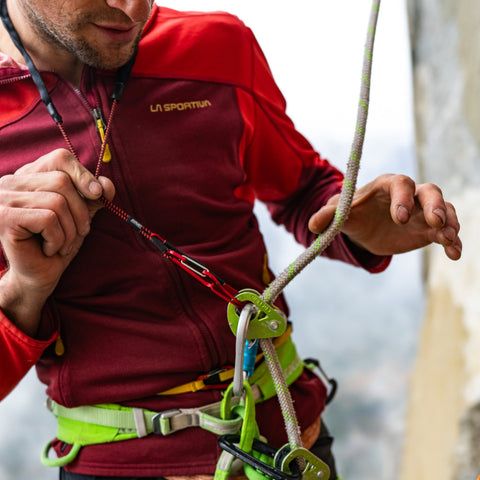
    In this month’s Prescription, an expert climber made two crucial errors in her rope ascension/top-rope solo system. She fortunately escaped with relatively minor injuries. This accident was featured in the 2024 Accidents in North American Climbing. On October 8, 2023 Whitney Clark was ascending a fixed rope at the start of Valkyrie (17 pitches, 5.11+) when her single ascension device was jammed by a sling. She fell 30 feet to the ground. Clark wrote to ANAC: “We woke at around 6 a.m. and made our way to the fixed line from the day before. The days were short and we had many pitches to do. My partner, Luka Krajnc, went first, using a Grigri to jug and then transitioning to climbing. About 40 feet up, he clove-hitched the rope to a bolt. I then started jugging with a single Micro Traxion. Thirty feet up, I leaned back on the rope. My body weight wasn’t supported because the sling around my neck [part of the top-rope solo setup] got sucked into the device and caught in the teeth of the Traxion. The rope was sliding against the sling. I hadn’t tied a backup knot.” Clark attempted to wrap the rope around her leg. But her rope was new, thin, and slippery. She wrote, “I grabbed the rope and slowly started sliding down. Eventually the rope burn was too painful and I let go. I hit the ground, landed on my feet, and fell backward. I struck my lower back and then my head. I was wearing a helmet. Because the ground was angled, some of the force was dissipated, though I landed six inches from a large rock spike. “I never lost consciousness but was in a bit of shock. Luka rappelled down and did a spinal exam. He got me comfortable, and I sat there for a while. I had pain in my back and my left ankle. I used my inReach to call for a rescue while Luka retrieved our stuff. I started crawling and butt-scooting to where a heli could reach me. I would have loved to have self-rescued, but it’s a 16-mile hike out. It took about 2.5 hours of crawling to make it to a flat place. Four hours later, a helicopter airlifted me to the Visalia Level III trauma center.”  Whitney Clark’s progress-capture device failed when the as-yet-unused retention sling got stuck in the device as she was ascending. It is common practice to use a sling and an elastic connection to hold the progress-capture device upright as one climbs along a fixed rope. Photo: Luka Krajnc Top-rope soloing is becoming increasingly popular. In this video, Pete Takeda, Editor of Accidents in North American Climbing, and IFMGA/AMGA guide Jason Antin are back to provide an accident analysis and give you some quick tips on how to mitigate risk when top-rope soloing. Top-rope soloing is an integral part of modern climbing. Currently, only one device (the El Mudo) is designed and commercially available for top-rope (and lead) soloing. There are many ways to configure these systems and we’ve demonstrated one possible solution here. Solo top-roping allows a climber to self-belay when no partner is available, for a team to work on individual sections of a route without the need for a belayer, or for two climbers to move simultaneously, as in this situation. The errors Clark made were using only one device to safeguard her progress and not tying a backup knot. “I was jugging by pulling on the rope, syncing up the slack, and sitting back,” Clark said. “The route was meandering and the fixed line didn’t allow me to readily climb, so I decided to jug straight up the initial blank slab. The sling around my neck was going to hold the Traxion upright [allowing the rope to feed freely] once I started climbing. I haven’t done any top-rope soloing since the accident. I probably will at some point, but I will definitely use two devices. This was the first time I only used a single progress-capture device.”  (Source: Whitney Clark.) Each membership is critical to the AAC’s work: advocating for climbing access and natural landscapes, offering essential knowledge to the climbing community through our accident analysis and documentation of cutting edge climbing, and supporting our members with our rescue benefit, discounts, grants and more. Plus, get the new 2025 member tee! https://americanalpineclub.org/news/2025/2/11/the-prescription
  • 0 Votes
    1 Posts
    197 Views
    UK ClimbingU
    UK-based charity makes mountains safely accessible to young people, aligning with Rab's values and brand heritage https://www.ukclimbing.com/forums/t.php?n=775128
  • 0 Votes
    1 Posts
    174 Views
    EpicTVE
    https://www.youtube.com/watch?v=euM23FI3xho
  • Fill The Void by Shay Skinner

    General News climbing climbingzine
    1
    0 Votes
    1 Posts
    235 Views
    ClimbingZineC
    https://climbingzine.com/fill-void-shay-skinner/