Skip to content

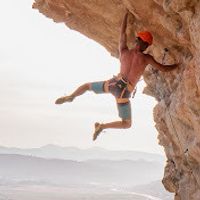
Mike Adams talks about his “Getting back into trad” autumn sends

General News
1 1 158 1

Suggested topics


  • The Line—Desert Towers in Saudi Arabia

    General News climbing
    1
    0 Votes
    1 Posts
    37 Views
    American Alpine ClubA
    Saudi Arabia is nearly ten times the size of Utah, and most of it is desert. Like Southern Utah, the terrain is riven with sandstone canyons and towers, nearly all of them unclimbed. Last January and February, a German trio did a three-week, 4,600-kilometer loop around the desert kingdom, exploring the traditional-climbing potential. So, how did their expedition turn out? It was a mixed bag.… Excited and somewhat stressed, we plunged into the crazy traffic of the seven million–strong metropolis of Riyadh in our rental car. Excited because a journey into the unknown lay ahead: a search for climbs in a country that has only been open to Western tourism since mid-2019. And stressed because only five of our six pieces of luggage had arrived. With a day to kill, Michael “Michi” Bänsch, Daniel Hahn, and I first shopped for supplies, then drove out of the metropolis toward the Edge of the World, a rocky escarpment northwest of Riyadh. The traffic was terrible; one construction site followed another. The entire country is being dug up; money seems endless. Due to the construction work, neither Edge of the World nor the stunning sandstone tower of Faisal’s Finger were accessible. But at least we spent a nice first night in the desert, giving us some relief and preparing us for the coming weeks. The next day, January 20, our last piece of luggage arrived. We took a deep breath and set off toward Wadi Al Disah, 1,300 kilometers to the northwest, fairly near the Red Sea. Settlements were very sporadic, and the closer we got to the Hejaz Mountains, the more fascinating the landscape became. When we entered Wadi Al Disah, our jaws dropped: endless sandstone cliffs, magnificent scenery, and potential for generations of adventurers. Atir Tower, the valley’s landmark, glowed in the evening light. After finding a place to sleep and cook dinner, we went swimming—yes, swimming! A stream flows through the wadi, providing gloriously green vegetation and offering us a welcome cool-off every evening. The next morning, we headed straight to the Atir, a 350-meter tower and one of the few Saudi formations with documented routes. It was climbed by a chimney route on the east side in 2013, by a party including Donald Poe, a U.S. oil engineer and Saudi Arabia resident. In 2020, a group led by Leo Houlding from the U.K. found a new line on the west face and named it Astro Arabia (5.11). We climbed the original route (UIAA V or about 5.7), hoping to encounter rock roughly akin to the well-known Wadi Rum in Jordan, about 230 kilometers to the north. In fact, the rock turned out to be quite brittle and dirty. But what a summit! Over the next few days, we searched for more climbable rock, which was harder than expected: There are endless formations, but upon closer inspection, many turned out to be too difficult, too fragile, or both. The fact that we did not have a drill or bolts didn’t make it any easier. But we soon made the first ascent of a beautiful tower (which had obviously been climbed by locals up to its forepeak), right at the valley entrance. We called it Burg (“Castle”) and the route Uralter Weg (“Ancient Path,” 80m, VI/5.10-). Further into the valley, another peak tempted us, perhaps 100 meters high and with what appeared to be a climbable route. Soon after we started climbing, however, we heard strange noises from below. The SFES (Special Forces Environmental Safety) rangers had spotted us and were ordering us back down. After a lengthy but quite friendly discussion, we were surprised to learn that climbing is prohibited in the entire Wadi Al Disah.  We detoured to a nearby canyon just to the north, Wadi Tarban (or Tourpan), where we climbed Gemini Tower (130m, 4 pitches, V+) and Porcelain Tower (scrambling plus 25m, VI), before being informed by friendly locals that climbing was not allowed there either. So, we left the Wadi Al Disah area earlier than planned and continued to Bajdah, a small town farther north, near the city of Tabuk, where we had been told climbing is officially permitted. Here, a completely different landscape awaited us: an open plain from which countless rocks rise, some enormous massifs, some picturesque needles. It may be hard to imagine, but deciding where to start in a sea of rock is truly challenging. But we soon found some nice objectives, including a two-pitch needle that we named Stoneman, climbed by a new route called Triumph des Willens (“Willpower,” ca 100m, VII-/5.10). We also reached all five summits of a formation we named Felsenbrüder (“Brothers of Stone”), about 150 meters high, by ... https://americanalpineclub.org/news/2025/12/16/the-linedesert-towers-in-saudi-arabia
  • The Corridor Wins 2025 Boardman Tasker Book Award

    General News climbing
    1
    0 Votes
    1 Posts
    44 Views
    GrippedG
    The jury unanimously said The Corridor by Iain Peters deserves this year's top prize The post The Corridor Wins 2025 Boardman Tasker Book Award appeared first on Gripped Magazine. https://gripped.com/news/the-corridor-wins-2025-boardman-tasker-book-award/
  • 0 Votes
    1 Posts
    64 Views
    GrippedG
    Jim Morrison is the first person to ski the entire north side of Everest, linking the Hornbein Couloir with the Japanese Couloir The post History Made as American Skis North Side of Mount Everest appeared first on Gripped Magazine. https://gripped.com/news/history-made-as-american-skis-north-side-of-mount-everest/
  • Mount Fuji Season Starts With New Rules

    General News climbing
    1
    0 Votes
    1 Posts
    94 Views
    GrippedG
    A higher entrance fee and a limit to how many people can ascend at once The post Mount Fuji Season Starts With New Rules appeared first on Gripped Magazine. https://gripped.com/news/mount-fuji-season-starts-with-new-rules/
  • Guidebook XIV—An Interview with Dougald MacDonald

    General News climbing
    1
    0 Votes
    1 Posts
    130 Views
    American Alpine ClubA
    How would you describe the scope of the work that goes into making the American Alpine Journal (AAJ)? Dougald MacDonald: Producing the AA J is a year-round effort that involves literally hundreds of people. The actual “staff” of the AAJ (who are all part-timers and volunteers) includes more than 15 people, and each year we work with roughly 300 individual climbers and photographers to share their stories. The book goes to press in late April, so the peak of the cycle is in March and April. But the work on the following year’s edition starts immediately, plus we prepare and upload online stories all year round. AND we produce The Cutting Edge podcast and the monthly Line newsletter. What’s the history of the AAJ? How has it changed over the years? DM: The AAJ is coming up on its 100th birthday, and unsurprisingly it has changed quite a lot over the years. It started out as much more of a Club publication, telling the stories of AAC members’ adventures. In the 1950s, with the rise of Himalayan climbing, the book started to become much more international. But it was really Ad Carter—who edited the AAJ for 35 years, starting in the 1960s—who created the wide-ranging, international publication it is today. We no longer focus mostly on the activities of AAC members—though we’re very happy to tell those stories when we can—but instead try to document all significant long routes and mountain exploration anywhere in the world, by climbers from every country. For both the AAJ and Accidents in North American Climbing (ANAC), the most significant changes of the last 10 to 15 years have been 1) the introduction of color photography throughout both books and 2) the launch of the searchable online database of every AAJ and ANAC article ever published. What’s an example of a unique challenge the editors have to deal with when making the AAJ? DM: One challenge is that we come out so long after many of the climbs actually happened. So, readers may have seen something about any given climb several times, in news reports and social media posts and even video productions. But the AAJ has never been in the breaking news business. Instead, we aim to provide perspective and context. Perspective in that we don’t have any vested interest that might slant a story one way or another, and context on the history and geography that helps readers really understand the significance of a climb, how it relates to what’s been done before, and what other opportunities might be out there. Another big challenge is language barriers, since we work with people from all over the world. We’re fortunate to work in English, which so many people around the world use these days. We also use skilled translators for some stories, and online translation tools have improved dramatically in recent years. But there’s still a lot of back-and-forth with authors to ensure we’re getting everything just right. What’s an example report that was really exciting for you to edit from the last few years? DM: For me, personally, the coolest stories are the ones that teach me about an area of the world—or a moment in climbing history—that I knew nothing about before starting to work on a story. In the upcoming book, for example, we have stories about winter climbing in Greece (who knew?) and a mountain range in Venezuela that’s gorgeous and has peaks over 16,000 feet. Unfortunately, that range is rapidly losing its snow cover and its small glaciers. AAJ senior editor Lindsay Griffin, who is editing the story, did some cool climbs in the range in 1985, and the difference between his photos and those from today is shocking. Are there any big differences in process between making the AAJ and ANAC? DM: The biggest differences are just the scale and scope of the two books: The AAJ is a nearly 400-page book that tries to cover the entir... https://americanalpineclub.org/news/2025/5/19/guidebook-xivan-interview-with-dougald-macdonald
  • Curitiba crowd roar Boulder men to World Cup glory

    Videos climbing ifsc
    1
    0 Votes
    1 Posts
    130 Views
    IFSCI
    https://www.youtube.com/watch?v=nnpxae8BA9c
  • Lara Neumeier Climbs 5.14R Trad in Austria

    General News climbing
    1
    0 Votes
    1 Posts
    124 Views
    GrippedG
    The top gear climber sent us some thoughts about the bold trad route The post Lara Neumeier Climbs 5.14R Trad in Austria appeared first on Gripped Magazine. https://gripped.com/news/lara-neumeier-climbs-5-14r-trad-in-austria/
  • The 7 Greatest Comp Climbing Rivalries of All Time

    General News climbing
    1
    0 Votes
    1 Posts
    115 Views
    climbingC
    Some rivalries are just as career-defining as the actual accolades athletes earn on the wall. https://www.climbing.com/competition/olympics/7-greatest-comp-climbing-rivalries-ever/